Search This Blog

Sunday, June 7, 2015

Railroad Park, The Bronx

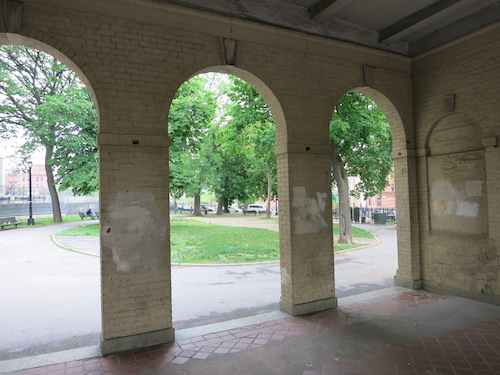
Railroad Park in the Melrose neighborhood of The Bronx has one, just one, notable feature, and that's the abandoned railroad station at East 161 Street. Though the station is long abandoned, Metro North's tracks still run underground right by the park.

railroad park bronx nyc

Opened in 1902, this humble three-quarters of an acre was named Melrose Park in 1920, and renamed Railroad Park only in 2001.

railroad park bronx nyc

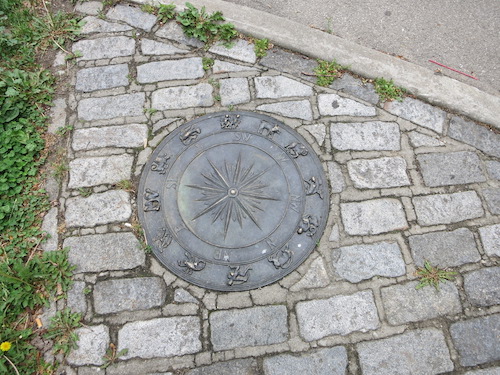
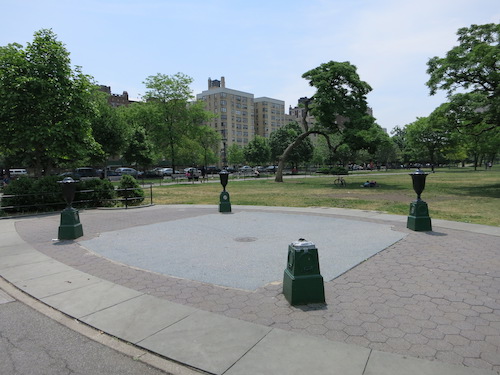
The compass rose in the pavement includes the signs of the zodiac. Nice touch.

railroad park bronx nyc

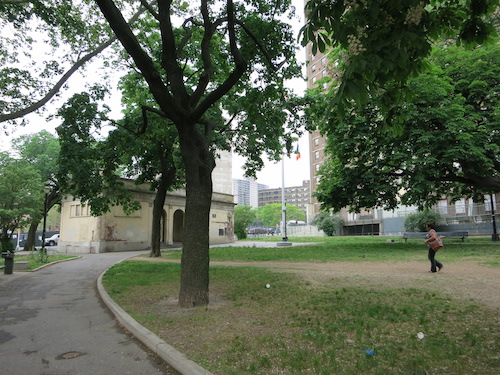
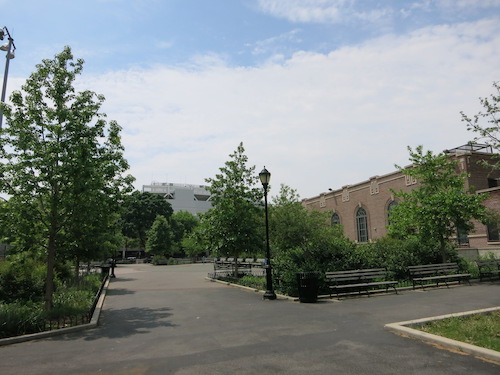
A curving path sweeps around the small park.

railroad park bronx nyc

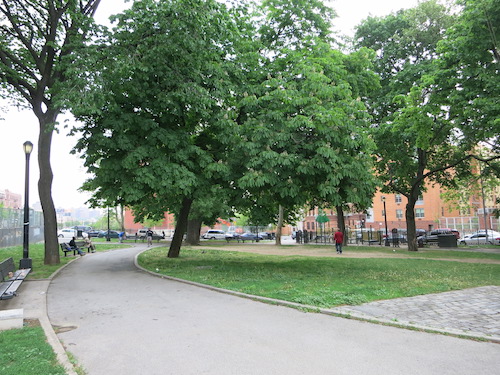
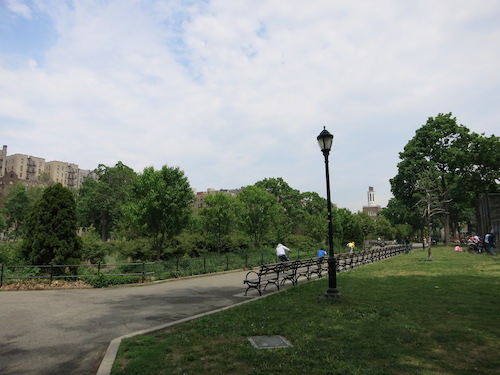
Here's the view toward the north, away from the station:

railroad park bronx nyc

It was starting to rain and it had been an energetic excursion, visiting five parks in a couple of hours. (See below for the other four.) Fortunately, seeing Railroad Park was the work of just a few minutes, so I didn't linger, and legged it back to the subway. There's a Railroad Park in Queens, too. That's for another day.

Monday, June 1, 2015

Franz Sigel Park

Another park that's an easy walk from Yankee Stadium in The Bronx is Franz Sigel Park, the rockiest and most forested of the area's green spaces (at least those you can enter without sneaking or blasting your way in).

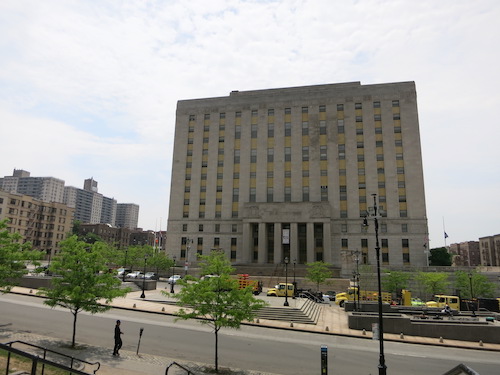
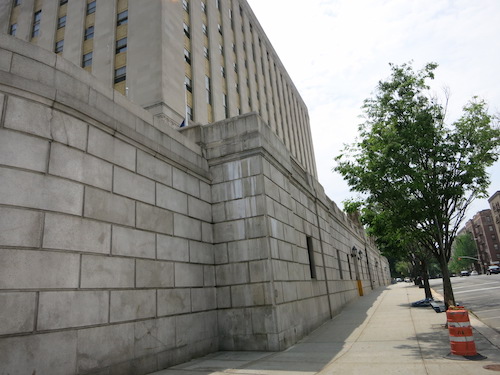
To get there I started at Joyce Kilmer Park and the Bronx Supreme Court at 161st Street, and walked down Walton Avenue, which, like Broadway in Manhattan, was once an Indian path.
franz sigel park bronx nyc

I passed the Congregation Hope of Israel building, which in its present condition isn't a very good advertisement for hope. According to BronxSynagogues.org, it closed in 2006. The same website explains that while over 360,000 Jews lived in the South Bronx in 1940, by 2007 the count had dropped to fewer than 2,500.
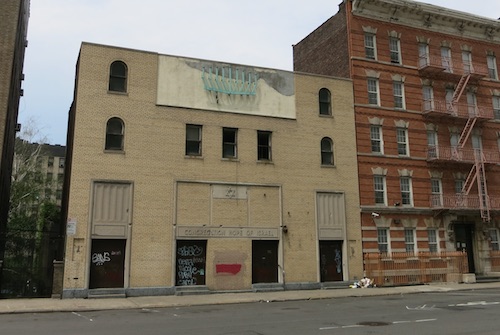
franz sigel park bronx nyc

I approached the western entrance to the park, and the appealing vistas made me take several photos before I even went inside. But the rocky ground, the trees, the stone wall and steps, and the smell of rich earth full of life got me going. What can I say? It felt like a pretty grand entrance.
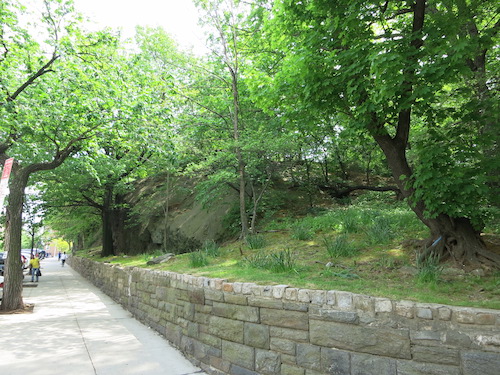
franz sigel park bronx nyc

Historic, too. According to the Parks Department website: "During the Revolutionary War, George Washington, Count de Rochambeau, and their respective American and French military staffs, used a high rocky ridge at the site to monitor the movements of British troops camped alongside the Harlem River."
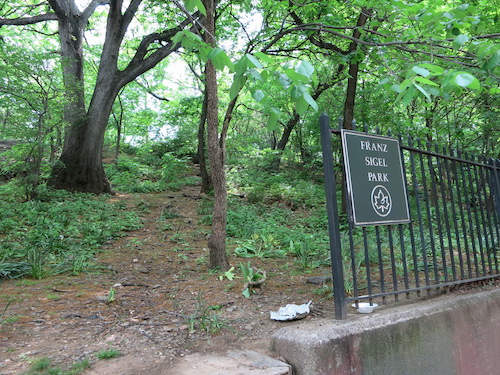
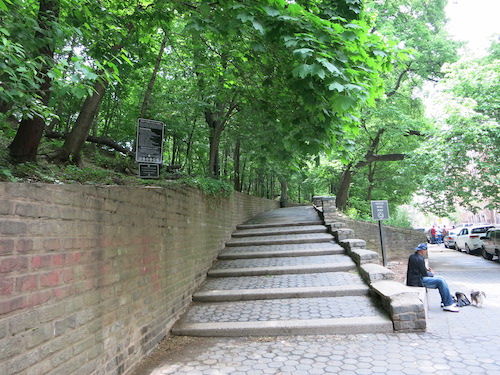
franz sigel park bronx nyc

With a little imagination, you can picture Washington with a spyglass here.
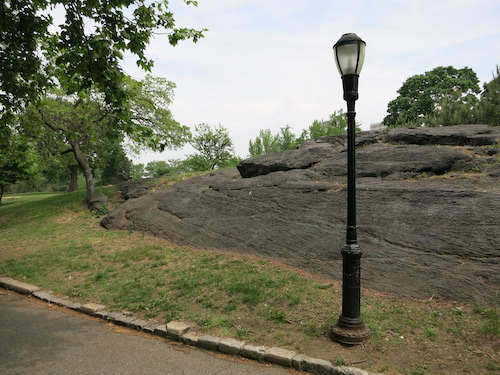
franz sigel park bronx nyc

Franz Sigel Park's modest heights don't offer sublime views today, but at least you can get a feel for their strategic value.
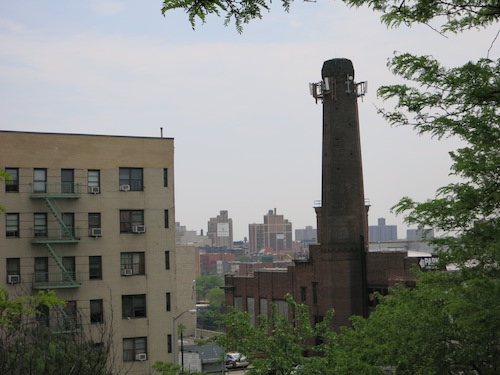
franz sigel park bronx nyc

Troops on waiting-around duty would be more comfortable today:
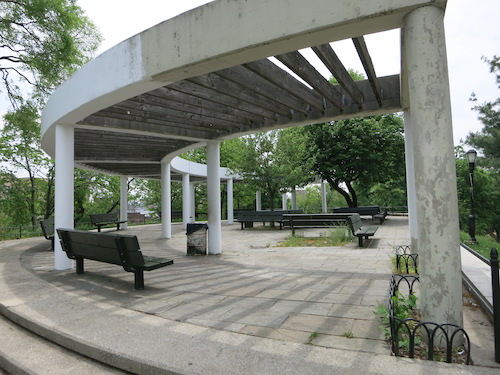
franz sigel park bronx nyc

Franz Sigel made his name in a different war. I knew the name looked familiar, and sure enough, there he is in the second volume of Abraham Lincoln: A Life, Michael Burlingame's tremendous biography, which I recently finished reading (and I'm not ashamed to admit it took a very long time).

Major General Sigel had good and bad moments during his Civil War duties in the Midwest. Unfortunately, he didn't look good at Wilson's Creek. Fortunately, he helped to win at Pea Ridge and end the Confederate threat against Missouri. Unfortunately, during the Spring Offensive of 1864 he got bogged down in the Shenandoah Valley.

Sigel's commission had been partly political, as Lincoln had constantly to soothe and placate the German-American constituency that had contributed to his election victory. In the book Burlingame calls the German "hypersensitive" and adds that Lincoln "tolerated Sigel's behavior because the general was popular with his countrymen, who formed an important voting bloc."

Sigel established himself in the U.S. after the German revolution of 1848. In 1852 he settled in New York City where he taught in public and German schools, joined the 5th New York Militia, and wrote, much like his fellow park commemoratee John Mullaly, for the newspapers, in Sigel's case the New York Times and the New Yorker Staats-Zeitung.

Over at Joyce Kilmer Park, I'd just seen the Lorelei Fountain, another mark of the German immigrant presence in The Bronx.

I've also learned that across the river, over on Riverside Drive in Manhattan, an equestrian statue by Karl Bitter (who was not German but Austrian) honors Sigel's contributions in the Civil War.

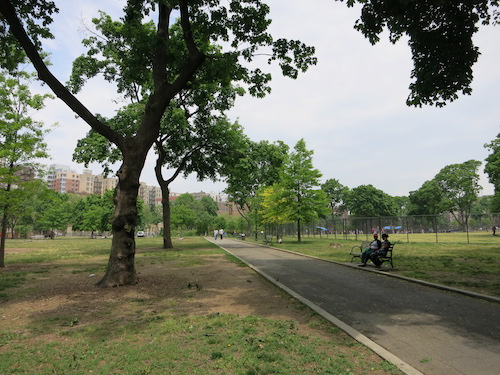
Towards the south end, near where the ballfields were added in the 1960s, Franz Sigel Park is bright and welcoming.
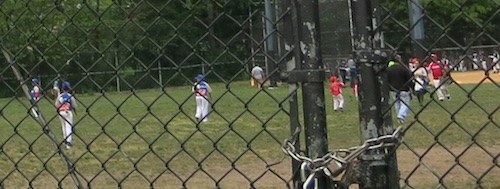
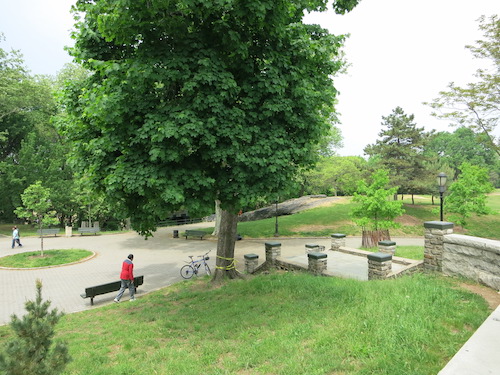
franz sigel park bronx nyc

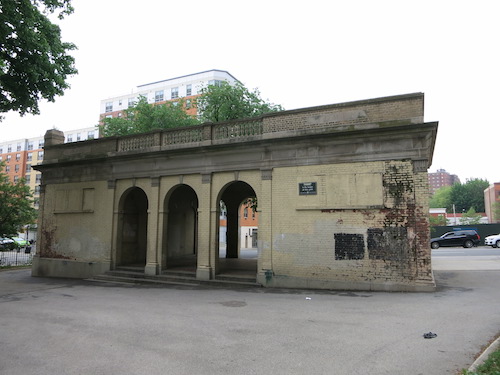
By contrast, an abandoned structure near the park's west side – an erstwhile bathroom facility? – looks like just the place for a mugging.
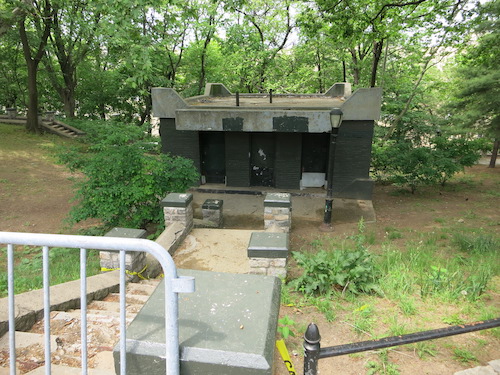
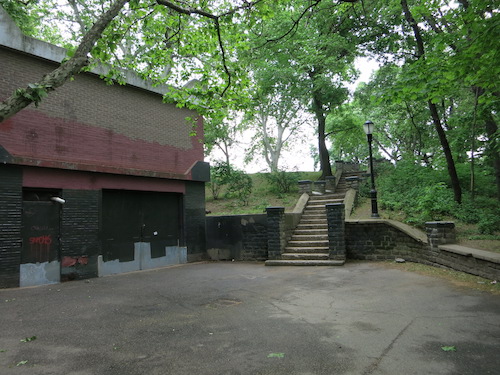
franz sigel park bronx nyc

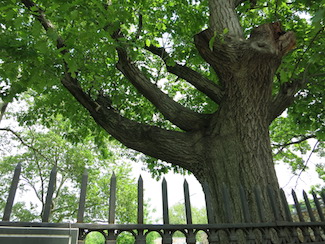
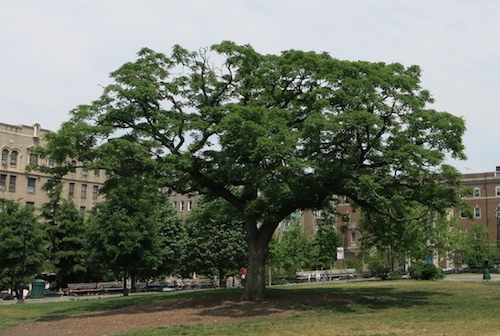
Here's one of the most common types of tree found in NYC, a London plane tree (Robert Moses loved to plant these), in a shape I've never before seen one stretch to.
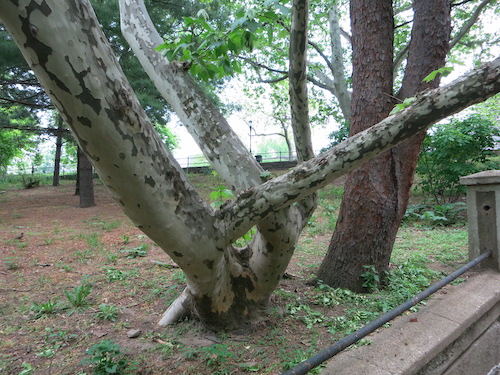
franz sigel park bronx nyc

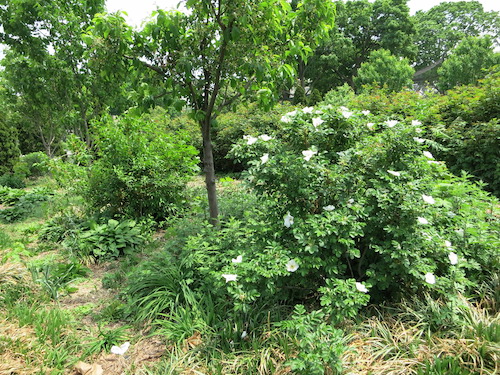
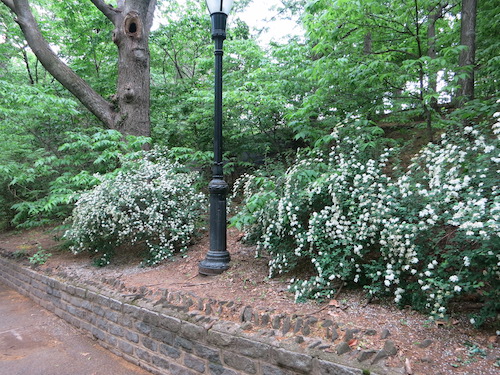
On the way out, headed for the final leg of my Bronx parks excursion that day, I couldn't help capturing this composition of lamppost, tree, flowering bushes, and wall. Then it was on to Railroad Park.
franz sigel park bronx nyc

Tuesday, May 26, 2015

Mullaly Park

“mullalyNobody deserves to have a park named after him more than the park visionary John Mullaly, who became known as the "Father of the Bronx park system" in the late 19th century, before the Great Consolidation of 1898 in which the five boroughs – Manhattan, Brooklyn, Queens, The Bronx, and Staten Island – became one New York City.
Mullaly, Secretary of the New-York Park Association formed in 1891, aimed "to secure increased park area for the City of New-York" and called for "at least…two great breathing places beyond the Harlem River." By "beyond the Harlem River" he meant the three towns New York City had annexed in 1874: Morrisania, West Farms, and Kingsbridge, which became part of the new borough of The Bronx.

The results of Mullaly's commission: nearly 5,000 acres of parkland, comprising Van Cortlandt, Claremont, Crotona, St. Mary's, Pelham Bay, and Bronx Parks. (That last one encompasses the New York Botanical Garden and the Bronx Zoo.)

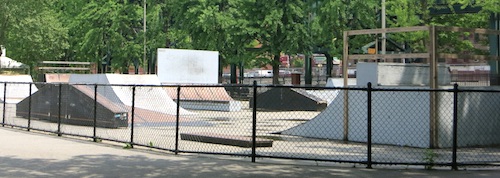
Mullaly died in 1911, or 1914, or 1915. (Internet sources disagree.) In the 1920s the City of New York acquired the land that would become Mullaly Park in the High Bridge section of The Bronx. The city has developed it over time beginning in the 1930s "as a multi-use recreational facility that complements Macombs Dam Park to the south," to quote the Parks Department website. It includes playgrounds, a pool, a skate park, basketball courts, and more.

mullaly park bronx nyc

But passive recreation is very possible here too. I entered at E. 165 St. and River Ave. and immediately encountered two totally passive people.

mullaly park bronx nyc

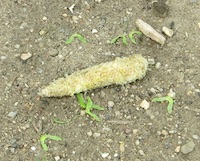
A second later, and a good deal less passively, I was nearly bonked on the head by a stripped ear of corn dropped out of a tree by a squirrel.“mullaly

I didn't see the squirrel. But the people on the bench explained that my attacker was indeed one of those ratlike creatures whose furry tails and liking for trees rather than trash make them cute. And it did seem the only rational explanation.

Up ahead was a large, densely planted garden area "with an irrigation system, blooming trees, and landscaping." (The pretty tower in the distance isn't a church, it's PS 114, the Luis Lorens Torres School.)

mullaly park bronx nyc

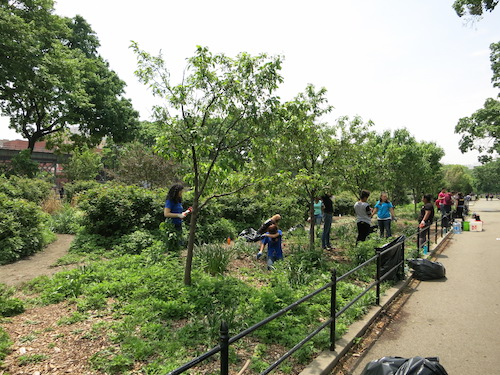
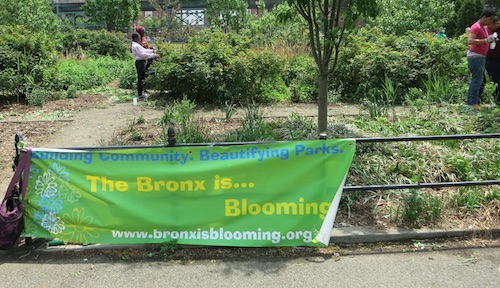
Actually there are two of these garden areas, both threaded with narrow winding paths. I had the southern one all to myself. An organized group of teenagers from The Bronx is Blooming was tending the northern one.

mullaly park bronx nyc

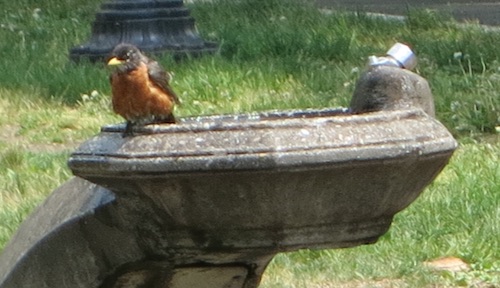
A splashing sound drew my attention, and I was just quick enough to catch this robin after his water-fountain bath.

mullaly park bronx nyc

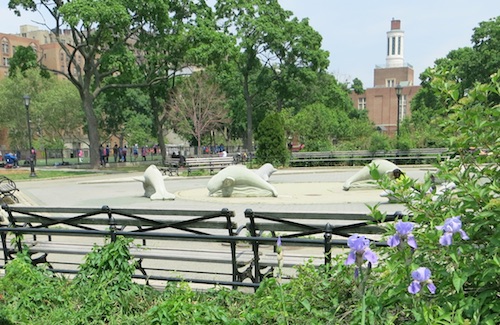
I like these playground dolphins too.

mullaly park bronx nyc

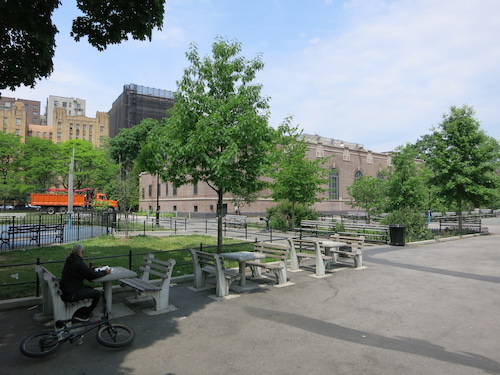
Back in the southern section, besides the skate park there's the big Mullaly Recreation Center (the brick building), more athletic facilities, chess tables, another playground, and a view of Yankee Stadium.

mullaly park bronx nyc

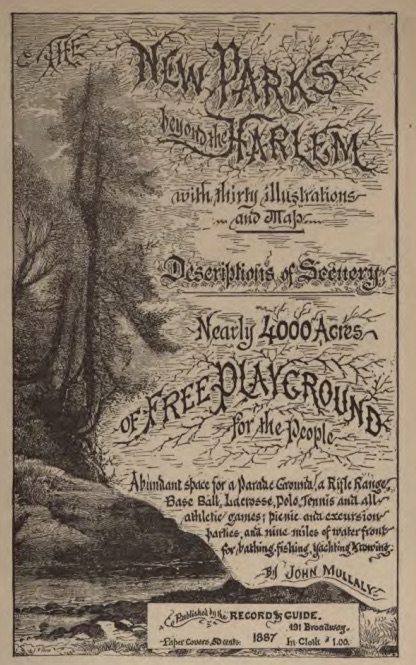
John Mullaly published a book in 1887 vividly describing his vision for the Bronx parks. Google has digitized the book and below is a screen shot of the fancy cover page. He was a fascinating character whose exploits went well beyond park planning: born in Belfast; Civil War draft resistance; a stint as New York Commissioner of Health; and finally dying "almost penniless…in a Second Avenue hall bedroom on a bitter day in 1914," according the October 20, 1929 edition of the New York Herald Tribune, a paper he had written for at yet another stage of his peripatetic career.

john mullaly park bronx nyc new parks beyond the harlem

"Nearly 4000 acres of free playgrounds for the people." Now that's my kind of visionary. If no one has written a biography of John Mullaly – and it doesn't seem that anyone has – someone ought to.

Friday, May 22, 2015

Joyce Kilmer Park

“joyceBeing an "English major for life," I suppose I should have known who Joyce Kilmer was, but I admit I didn't. I'd heard the name, but that's it.
Better late than never: now I know Joyce Kilmer was a he, and he was the poet who wrote "I think that I shall never see/A poem lovely as a tree." A famous Catholic writer and lecturer in his time, he was killed in World War I on the Western front in 1918 at the age of 31. And just a few blocks from Yankee Stadium, Joyce Kilmer Park in the Melrose/Morrisania section of The Bronx honors his memory – though he doesn't seem to have had any particular connection to the borough.

The former Concourse Plaza is a tall rectangle like a miniature Central Park, its southern and most dramatic entrance at 161st Street. Most of the park lies on flat terrain, but some picturesque rockage greets the visitor approaching from the south.

joyce kilmer park bronx nyc

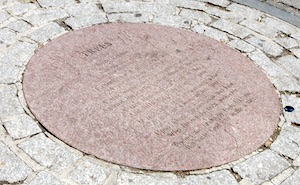
Because of the circumstances of Kilmer's death, the park named for him fits right in with all the doughboy monuments found in other parks throughout New York City, though there's no graven doughboy image in Joyce Kilmer Park. Nor is there an image of Kilmer, though "Trees" is inscribed into the pavement (see photo, above right).

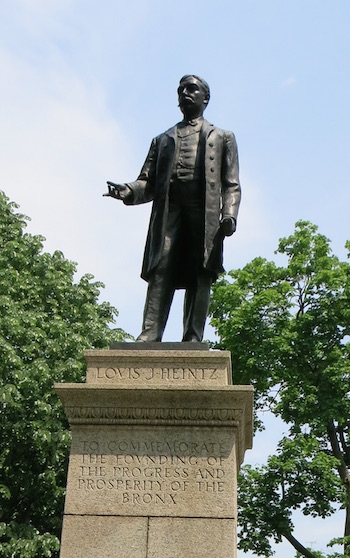
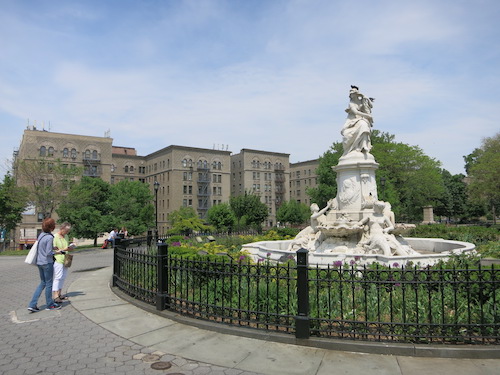
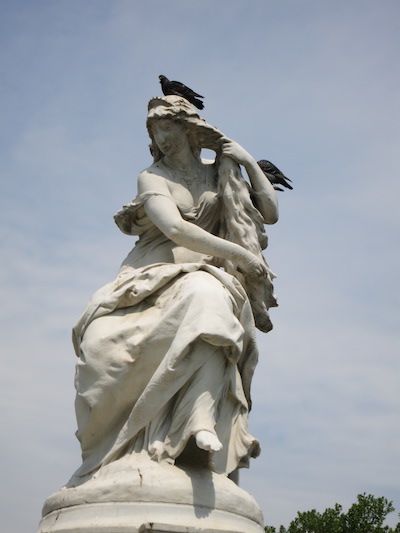
Instead of a doughboy statue, Joyce Kilmer Park has the Lorelei Fountain, also known as the Heinrich Heine Memorial, and a statue of Louis J. Heintz, the first commissioner of Bronx street improvements and progenitor of the Grand Concourse – a sort of Baron Haussmann of The Bronx.

What a lot of Germanic names in one little paragraph about one humble park! The fountain has an interesting history. Intended for Dusseldorf, the poet Heinrich Heine's hometown, Ernest Herter's sculpture was instead brought here from Germany after objections by, according to the Parks Department, "political groups opposed to Heine's Jewish origins and political views," and erected in 1899 through the largesse of German-Americans – much like the German Fountain in Santiago, Chile. I gather German emigrés of a century ago had a thing about fountains.

joyce kilmer park bronx nyc

The Lorelei Fountain was the only place I saw tourists on my Bronx parks excursion last week. In the photo above, the two women on the left were looking at the monument while consulting a guidebook. I didn't listen in to see if they were speaking German.

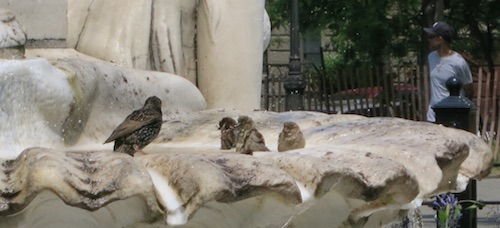
The fountain also attracts a lot of birds, as fountains are wont to do.

joyce kilmer park bronx nyc

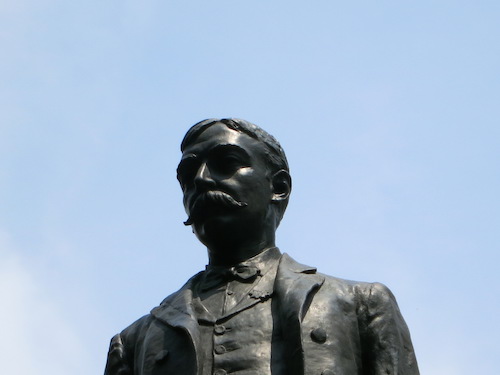
The monument to Louis J. Heintz commemorates "the founding of the progress and prosperity of The Bronx." The sculpture by Pierre Fietu dates from 1909.

joyce kilmer park bronx nyc

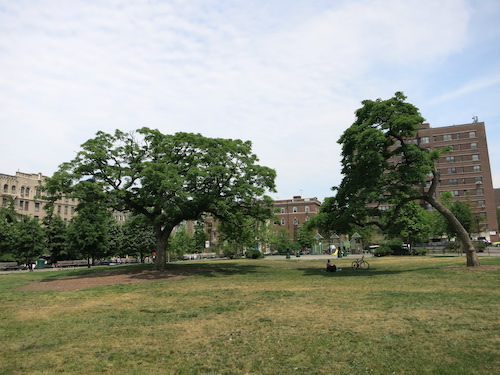
But most of the park is plain old grass and trees, with a playground at the north end.

joyce kilmer park bronx nyc

Four urns once surrounded this little plaza by the playground. And then there were three…

joyce kilmer park bronx nyc

Poets and other writers used to mean a lot more to park visionaries than they do now. There's the Poet's Walk or Literary Walk in Central Park, of course, with its statues of Robert Burns, William Shakespeare, Sir Walter Scott, and the now otherwise forgotten Fitz-Greene Halleck. There's Dante Park. Clement C. Moore Park. And of course there's Underwood Park, named for the typewriter magnate without whose products no one could have typed their poems in the first place.

Fitting words for a city of immigrants:

I had a lovely homeland long ago.
The oak trees
Grew so high there, the violets nodded softly.
It was a dream.

- Heinrich Heine, "Ich hatte einst"

Trite, but true:

I think that I shall never see
A poem lovely as a tree.

- Joyce Kilmer, "Trees"

joyce kilmer park bronx nyc

Wednesday, May 20, 2015

Macombs Dam Park

I've been a Mets fan all my life, always carrying some of the Yankee Resentment that goes with that. Having never been to a Yankee game, I've never gotten to know the Yankee Stadium area of the Bronx.

It was time to change that, so this past weekend I explored five parks in walking distance of the stadium. The first is an extravagant exception to my blog rule disqualifying parks that exist only for athletics. Macombs Dam Park, on the site of the old Yankee Stadium, merits coverage twice over: for its history and for its aesthetics.

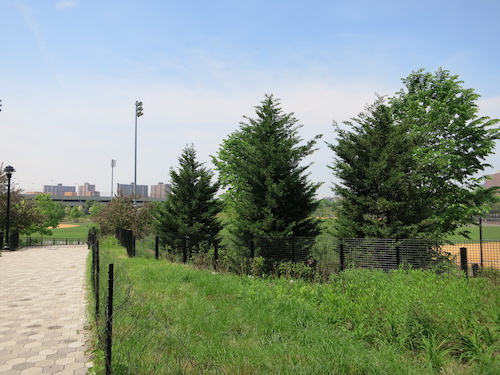
macombs dam park yankee stadium bronx nyc

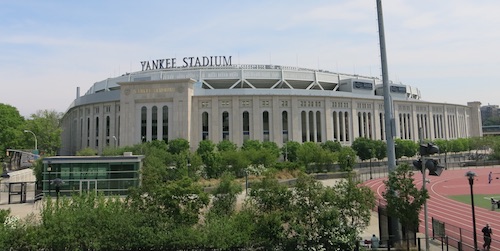
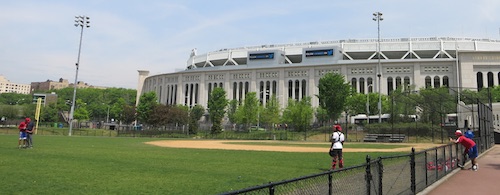
Just across 161st Street from the new Yankee Stadium, Macombs Dam Park is named after an actual dam built across the Harlem River in 1814. I'd always wondered why the nearby Macombs Dam Bridge was named thus. Dams are not the first thing one thinks of in reference to New York City's waterways. But gristmill operator Robert Macomb managed to get the city's approval to build one two centuries ago.

Years later concerned citizens protested the blockage of the river by attacking the dam both rhetorically and physically. It was gone by 1858. In 1890 the accompanying bridge was replaced with the current Macombs Dam Bridge, described in this Forgotten New York post dating from before the creation of the park.

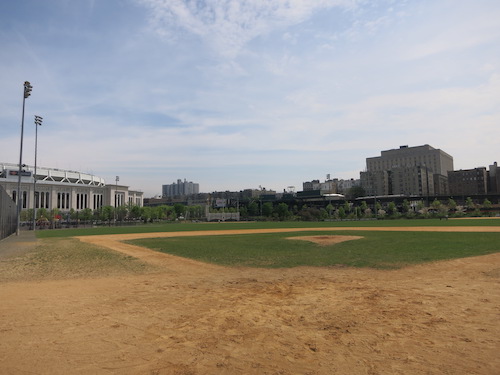
The bridge was already 13 years old when the New York Highlanders (later renamed the Yankees) came into being in 1903. Ten years later the team moved across the river from the Polo Grounds in Manhattan to the newly built Yankee Stadium in The Bronx. One of the baseball fields in Macombs Dam Park is situated exactly over the diamond of that original Yankee Stadium, so you can stand (and even play ball) where Babe Ruth, Mickey Mantle, Mickey Rivers, and Derek Jeter once batted.

macombs dam park yankee stadium bronx nyc

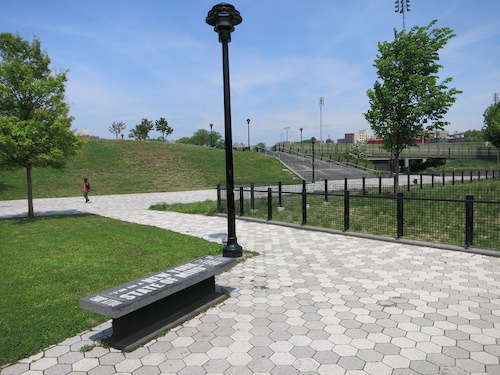
Grassy landscaping and markers of the history of the Yankees and the stadium ring the baseball fields.

macombs dam park yankee stadium bronx nyc

No doubt the fields are bustling with baseball on weekends. But on this weekday afternoon, as beautiful a day as it was, only a few people had come out.

macombs dam park yankee stadium bronx nyc

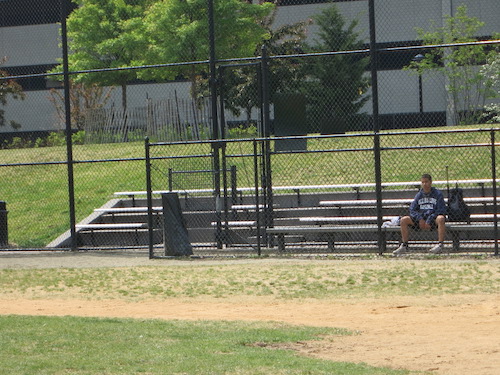
One forlorn-looking young man sat alone in a dugout. Was he dreaming of the big leagues? Or just early for a practice or a friendly game?

macombs dam park yankee stadium bronx nyc

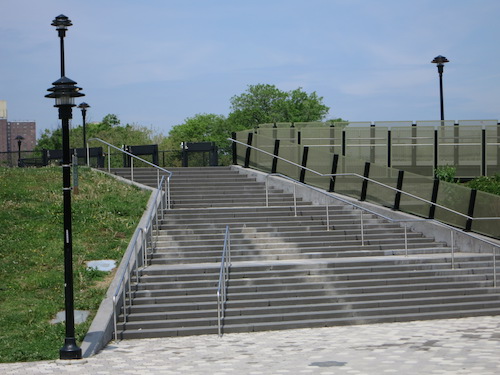
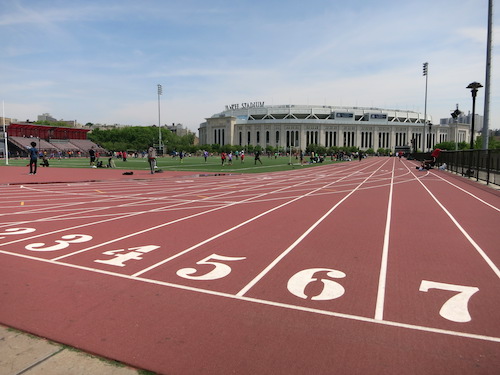
From the baseball fields you can ascend via stairs or a ramp to the Joseph Yancey track and field area, which was much busier.

macombs dam park yankee stadium bronx nyc

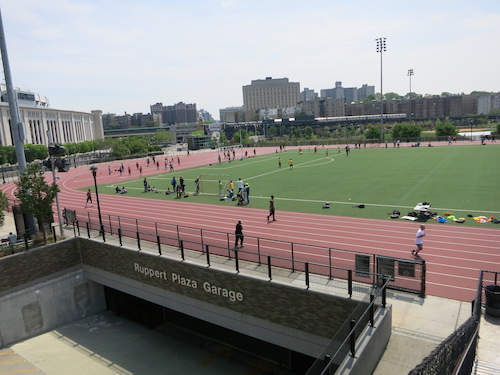
Driving? Park in the Ruppert Plaza Garage, named for Colonel Jacob Ruppert, onetime Yankees co-owner, and builder of the original Yankee Stadium. Ruppert has a park named for him too, in upper Manhattan.

macombs dam park yankee stadium bronx nyc

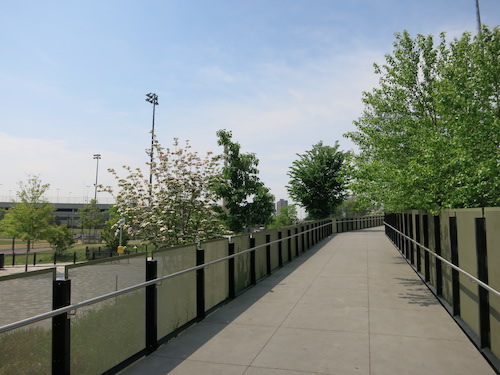
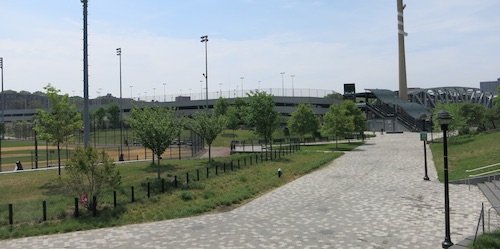
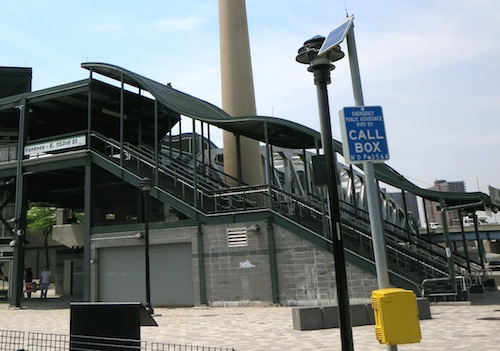
Eye-pleasing design makes this big athletic facility parklike and just plain nice to walk around in. I'll close with some aesthetics. Here's a view showing some of the landscaping. The curved shape on the far right is the Yankees - East 153 St. Metro-North train station, which opened in 2009. I'm sure Yankee fans from the northern suburbs appreciate its utility. This Mets fan appreciates its architecture.

macombs dam park yankee stadium bronx nyc

Good job on this one, MTA.

macombs dam park yankee stadium bronx nyc