Search This Blog

Showing posts with label West Village. Show all posts

Wednesday, September 20, 2017

The Gardens at St. Luke's

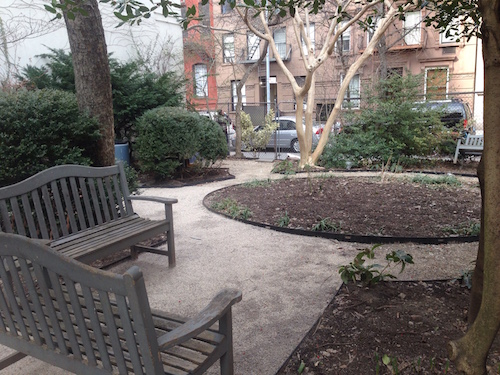
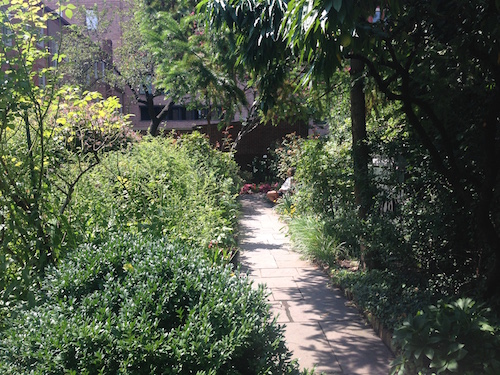
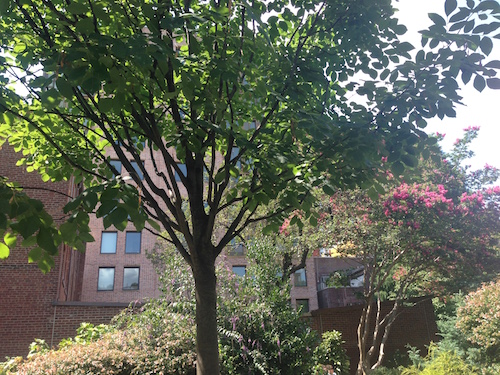
The Gardens at the Church of St. Luke in the Fields were resplendent in green when we stopped by in mid-August. Open to the public most days, the private gardens of the 1821 West Village church date from the 1950s.
gardens church st lukes in the fields manhattan nyc

A brochure available in the Gardens describes "more than two-thirds of an acre of walks, lawns, and a fine collection of garden standards, rare hybrids and native American flora," and "a small but important way-station for migrating birds and butterflies during the spring and fall seasons," with "heat-retaining brick walls" that "create a warm microclimate."

gardens church st lukes in the fields manhattan nyc

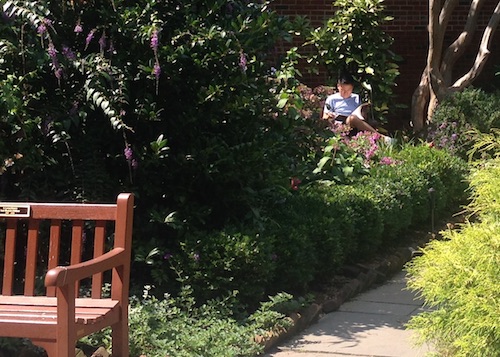
It's a peaceful retreat for a quiet read.
gardens church st lukes in the fields manhattan nyc

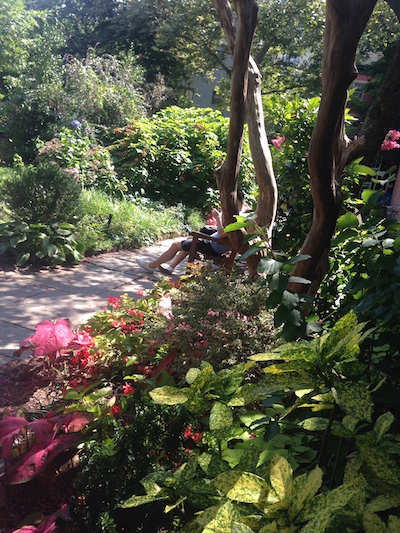
The planting is so dense it can almost feel tropical.
gardens church st lukes in the fields manhattan nyc

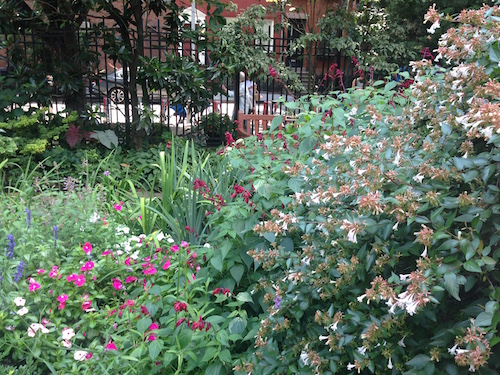
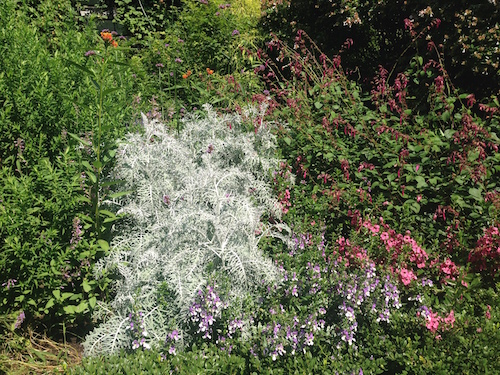
Well into the summer, there remained plenty of color to please the eye.
gardens church st lukes in the fields manhattan nyc

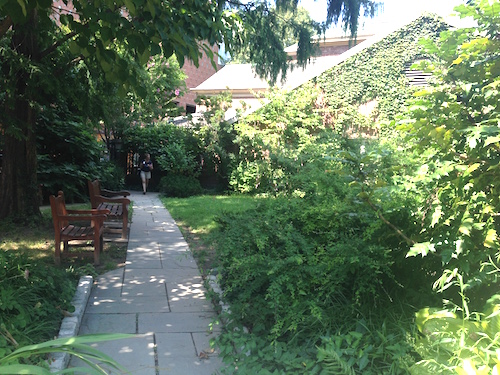
No one talks about pavement. But I'm partial to bluestone paving. (Speaking of color.)
gardens church st lukes in the fields manhattan nyc

This is one of those places you can lose yourself, forget you're in the city. As Atlas Obscura observes, "Although the garden is scattered with benches, few are regularly occupied. The occasional West Village resident ducks in to read or snack or sit, but no one within the garden's confines generally speaks louder than a whisper."

It's perfectly appropriate that this place should be a peaceful refuge. Nearly 200 years ago, the founders of the Church of St. Luke in the Fields named their new congregation after the physician evangelist "in recognition," the church's website explains, "of the village's role as a refuge from the yellow fever epidemics that plagued New York City during the summers" – a reminder, among other things, of a time when Greenwich Village was an actual village. The Greenwich Village Society for Historic Preservation describes people beset by yellow fever and cholera in the late 18th and early 19th centuries fleeing "north to the wholesome backwaters of the West Village," where the population quadrupled from 1825 to 1840.
gardens church st lukes in the fields manhattan nyc

There's no population explosion here, though. Just an explosion of flora.

All photos © Jon Sobel, Critical Lens Media

Friday, July 21, 2017

Washington Commons

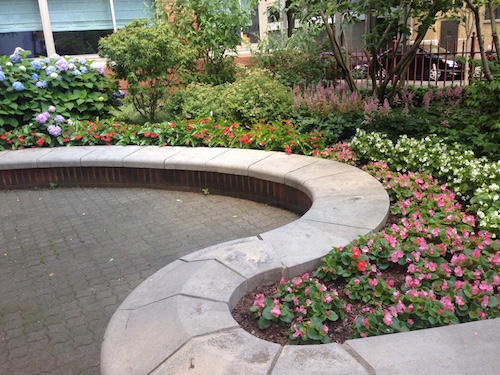
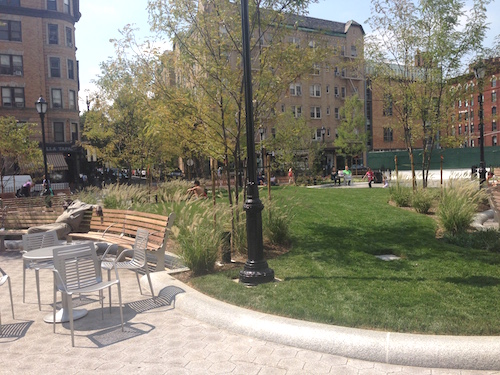
The design of Washington Commons – not the bar in Brooklyn, but the pretty little public space in Manhattan's West Village – makes it seem bigger on the inside, like some horticultural TARDIS. And in fact there is a bit of time travel you can do here.

washington commons west village manhattan nyc

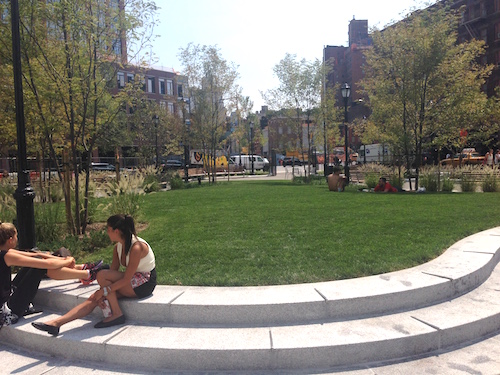
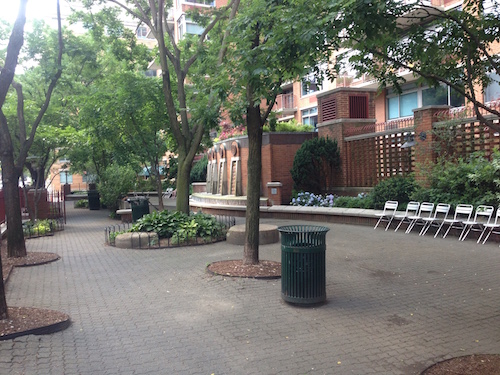
Nice curves make a space welcoming, as Frederick Law Olmsted knew.

washington commons west village manhattan nyc

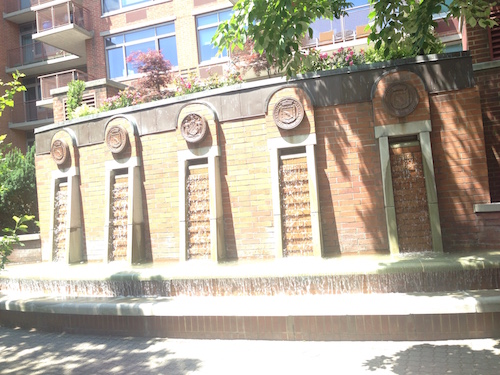
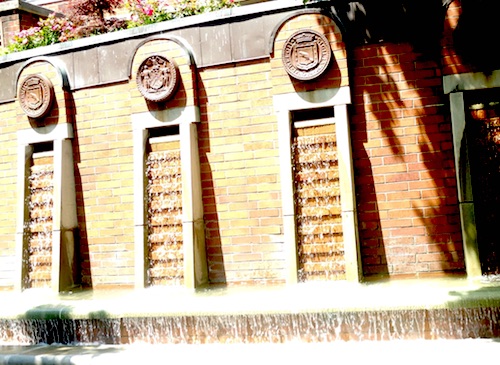
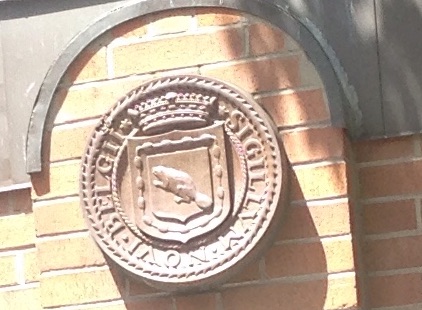
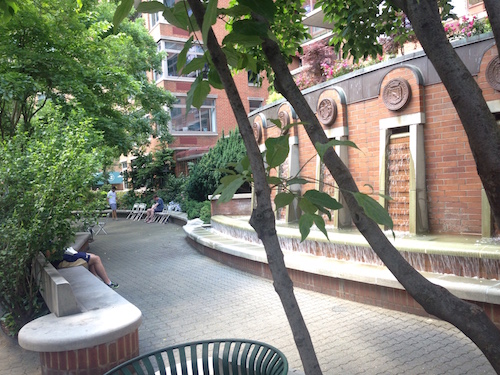
The little park's dominant architectural feature is its waterfall, bedecked with historical seals of the City of New York. The one with the beaver bears the slogan "SIGILLUM NOVI BELGII," "Seal of the New Belgium." Among the first settlers the Dutch West India Company plunked down in New Amsterdam were 30 French Walloon families, from a part of the then-Netherlands that became Belgium. There's a Walloon Settlers Memorial in Battery Park.

washington commons west village manhattan nyc

The designers didn't put in much in the way of seating – I suspect on purpose to discourage visits from nonresidents of the development this grudgingly public space abuts. In fact, according to The New York Times, the park "resulted from negotiations between community leaders and [the] Rockrose [Development Corporation], which needed a [zoning] variance to build a parking garage."

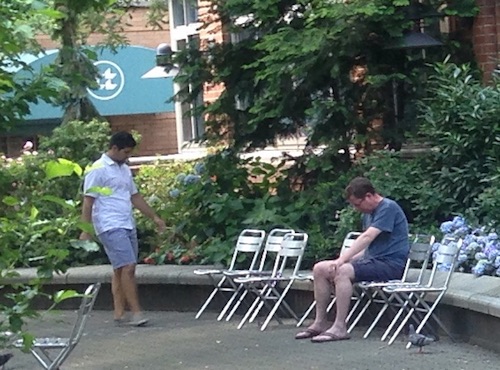
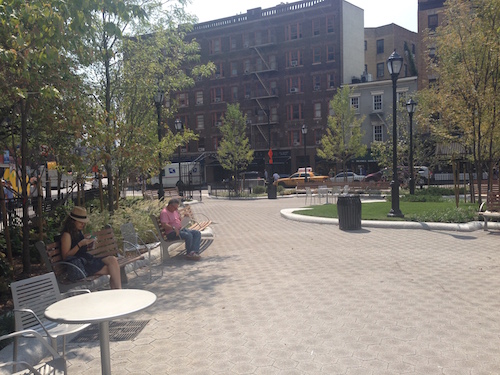
On a beautiful day in early summer, though, someone has realized that people do in fact enjoy a pleasant sit.

washington commons west village manhattan nyc

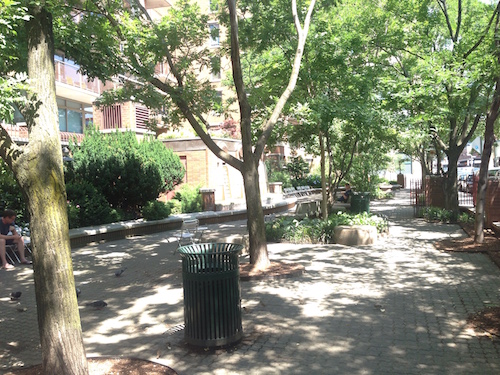
The trees make dappled shadows on the wavy-stoned ground.

washington commons west village manhattan nyc

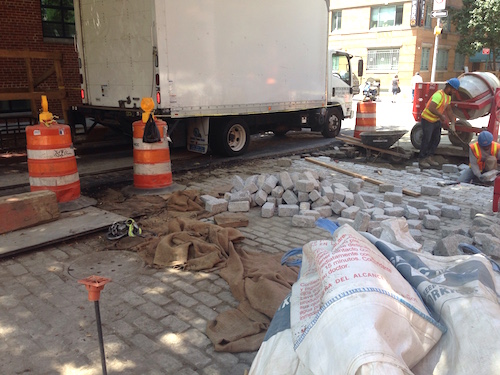
As it happened, a work crew was replacing some of the nearby cobblestones on Jane Street. New York's original cobblestones, brought over from Europe as ballast, are more accurately called Belgian block. So everywhere you go in this neighborhood, you seem to run into Belgium – without the fat and calories of fries.

jane street cobblestones greenwich village manhattan nyc

All photos © Jon Sobel, Critical Lens Media
Saturday, April 29, 2017

Jane Street Garden

I don't give community gardens much attention on this blog, as they're not usually very park-like. Jane Street Garden in Manhattan's West Village neighborhood is an exception, and more than a community garden anyway, notable for its long history (it was established in 1973) and relatively permanent status as well as its landscaping and carefully maintained condition.

Even on a cloudy February day, the garden looked inviting through the fence, geometrically speaking at least.

jane street garden west village manhattan greenwich village nyc

But when I read in a Gardener's Eye blog post from 2016 that it's open weekends from 9AM to 1PM "or whenever the gate is open weather permitting," I made a point of returning in April. And sure enough:

jane street garden west village manhattan greenwich village nyc

According to WestView News in a brief piece from January 2017 titled "Jane Street Garden Remains Resilient as Ever," "The garden is now being prepared to accommodate a new iron fence with a corner entrance. It is being funded by Councilman Corey Johnson and will be installed by the Parks Department in 2017." If a City Councilman and the Parks Department are involved, and there's no looming threat of development overrunning it, I say it's a park.

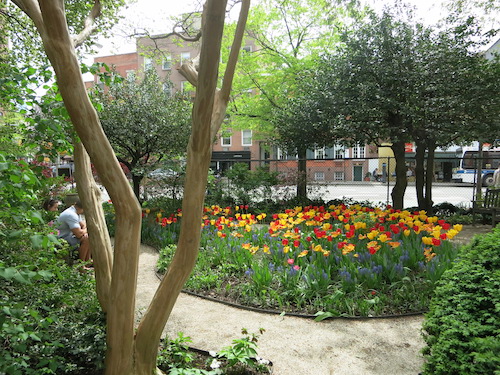
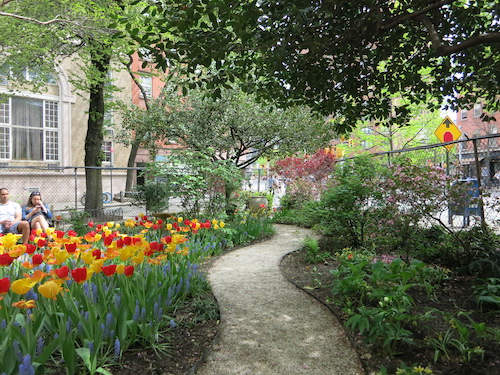
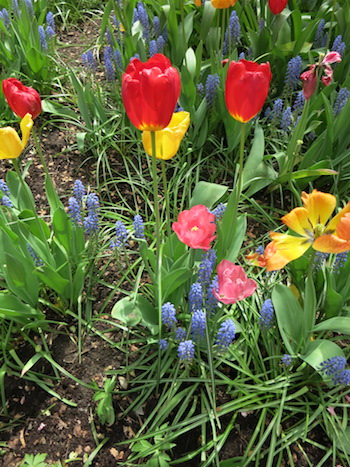
Plus, tulips.

jane street garden west village manhattan greenwich village nyc

For a detailed – maybe too detailed – account of the complexities behind the park's birth, plunge into this 2007 account in The Villager by Patricia Fieldsteel. Here's just a bit of her dizzying yarn:

New York was in decline, sliding toward bankruptcy; people were leaving in droves for safer, greener places. The Jane St. Block Association raised money to buy trees for the then-treeless street. A chicken-wire fence was put around the garden; benches and seats added. The dress designer Mollie Parnis recognized the garden with a Dress Up Your Neighborhood Award in 1974.

Then in 1975, a catastrophe of cosmic proportions occurred. The plot, now known as “36 Jane Street, Block 625, Lot 34,” was bought at auction by a novice real estate developer, 26-year-old Gregory Aurre, Jr., of W. 12th St. Overnight, the garden was neck deep in mud. Aurre hired architect Stephen Lepp to design a four-story combined apartment/commercial building for the site. Jane Streeters charged the plan wasn’t in keeping with the street. Rumors circulated that quickly became accepted as fact: The building was to be a high-class brothel.

Sure enough, there's definitely some seedy love happening in this tiny triangular oasis.

jane street garden west village manhattan greenwich village nyc

The layout of paths and the angles of the benches make it seem bigger than it is.

jane street garden west village manhattan greenwich village nyc

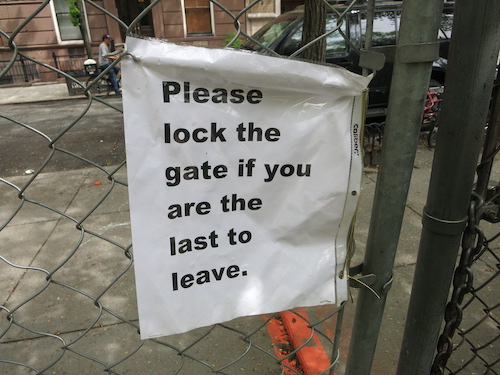
There's an endearing kind of honor system at work too. How often do you see a display of trust like this on city streets?

jane street garden west village manhattan greenwich village nyc

Saturday, September 12, 2015

St. Vincent's Park - 76 Greenwich Avenue

Manhattan's newest park is open, but it may not officially be a park yet.

It's hard to tell from the non-Parks Department sign, which mentions only the address of the adjoining building, 76 Greenwich Avenue. But a quick web search turned up a public letter on the city government website calling for transferring this newly landscaped open-space triangle to the City and naming it St. Vincent's Park.

The letter, from Community Board #2 to the City Planning Commission, explains that "This park was part of the deal made in 2011 by the Rudin Management. The developer promised to build a public park on this triangular plot of land as part of the approval to convert the old St. Vincent's Hospital site into condos."

A visit tells the story: The public park has been built.

st vincents park 76 greenwich avenue manhattan nyc

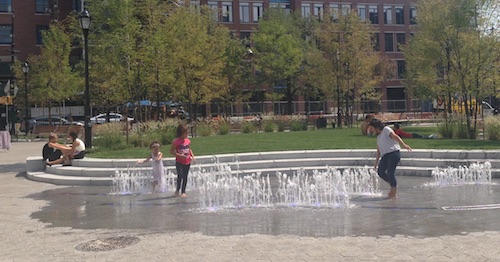
It has a fountain (complete with picturesque children playing in it), benches (complete with a sleeping man), tables and chairs, and, according to the sign, 36 trees and 19 light poles.

st vincents park 76 greenwich avenue manhattan nyc

Evidently, though, it's still awaiting transfer to the Parks Department. Or at least new signs.

st vincents park 76 greenwich avenue manhattan nyc

A replacement for St. Vincent's hospital, which closed a couple of years ago amid enormous controversy, it is not. Still, it looks like a nice little addition to the neighborhood.

st vincents park 76 greenwich avenue manhattan nyc

All photos © Jon Sobel, Critical Lens Media
Saturday, August 31, 2013

Bleecker Playground

One of the various factors making visiting every New York City park a Herculean task, aside from the sheer quantity, is inconsistent nomenclature. Athletic fields and playgrounds in themselves don't count as parks for this blog. But some "playgrounds" aren't just playgrounds.

Next to Bleecker Playground in the West Village, for example, and completely fenced off from the kids' play area, is a spacious, nicely landscaped seating area. Granted there were no children playing in the playground when I walked through the other day, but it felt like a peaceful oasis. So here it is (trumpets, please): the Bleecker Playground seating area.

But what, you ask, is that dancingly expressive statue in the first photo above? The Parks Department website is happy to oblige with the answer: it's Chaim Gross's The Family, "dedicated by the artist to former Mayor Edward I. Koch in 1992," the year after Gross died. I don't know why they had to rename the Queenboro/59th St. Bridge after Koch when he already had this nifty sculpture (and the bridge already had two perfectly good names). And who actually did the dedicating?

Another good question: Why is one section of this park paved in wooden boards? In any case, since my next post will take us to Coney Island, it makes a good transition. The sunlike image in the window is, I think, a display at the James Perse store, but I didn't want to get too close and burn my eyes (or melt my wings).

Finally, while I suppose none of us really needs to see yet another picture of a chess table, I like these solid-looking pieces of old furniture, and the presence of one does prove – to me at least – that this is indeed a New York City park.