Search This Blog

Tuesday, September 8, 2015

Wolfe's Pond Park

wolfes pond park staten island nyc battle of the bulgeWith a beach, freshwater ponds, a forest, lots of recreation facilities, and even a Battle of the Bulge memorial, Wolfe's Pond Park covers more than 300 acres on the south shore of Staten Island, split across the middle by Hylan Boulevard, one of the island's main thoroughfares. The park includes part of the Staten Island Bluebelt, a huge storm drainage and landscape architecture project that's still in progress.

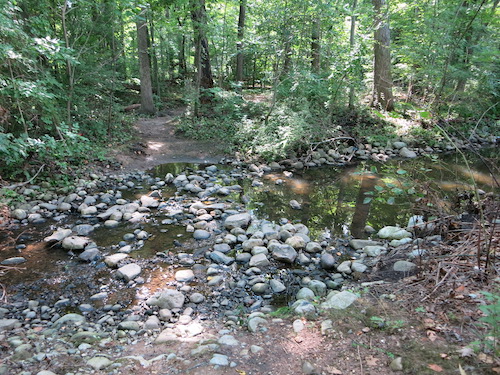
A Bluebelt sign greeted us as we made an initial stab into the park from its northern end, thinking we might be able to find paths all the way through to the pond and the shore.
wolfes pond park staten island bluebelt nyc

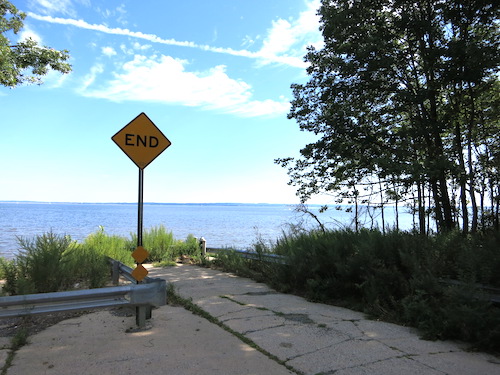
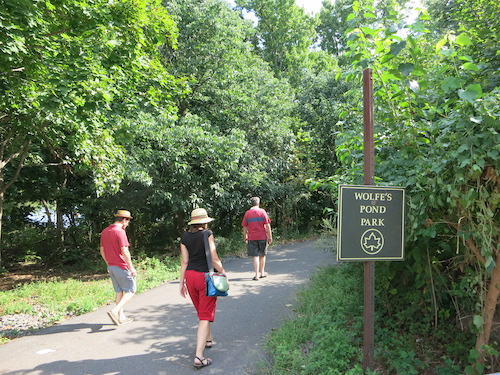
The trail was clear, but with neither a map nor the right footwear for the terrain, we decided to drive down to the beach end instead.
wolfes pond park staten island nyc

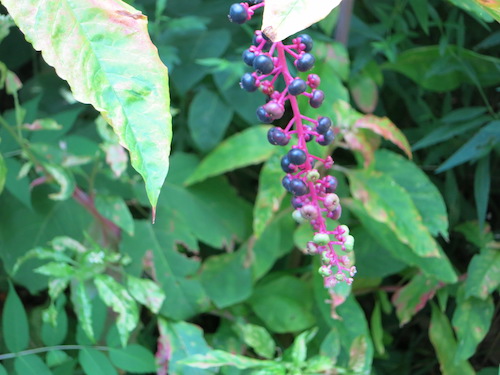
If you see berries that look like the ones in the next photo, do not eat them. It's pokeweed. Pokeberries are deadly poisonous to humans, although, according to Outdoor Life, birds and deer and other animals can eat them with no problem.
wolfes pond park staten island nyc

Can dogs eat pokeberries? Outdoor Life doesn't say. They can have a good time in the Wolfe's Pond Park dog run, though. Because of the clean-looking wood-chip surface (and the absence of dogs) I didn't even realize it was a dog run until I noticed the POOCHES sign on the shed.
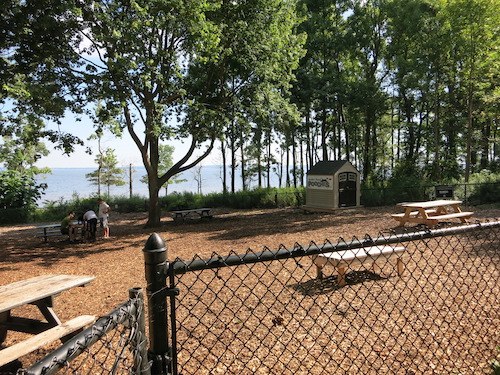
wolfes pond park staten island nyc

Walking a winding path through the high shrubbery gave us our first view of the beach, which looks pretty nice, even though this summer a New Yorkers for Parks report rated it the worst of eight city beaches. (Like other Staten Island beaches, it suffered damage during Hurricane Sandy.)
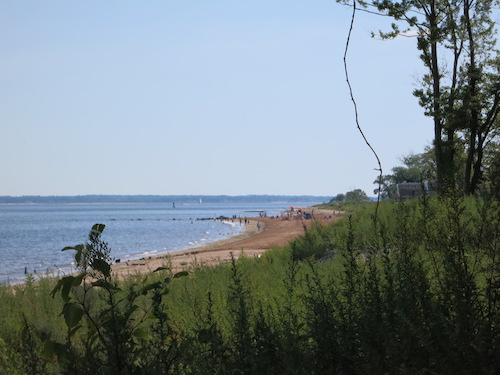
wolfes pond park staten island nyc

Basketball courts, tennis courts, even a hockey rink were in use. Absolutely not in use was this fenced-off, overgrown playground . The equipment doesn't look old. Hurricane Sandy shut off the "lights" here, I believe. There's a notation on the parks department website that restoration of the playground and surrounding paths is underway.
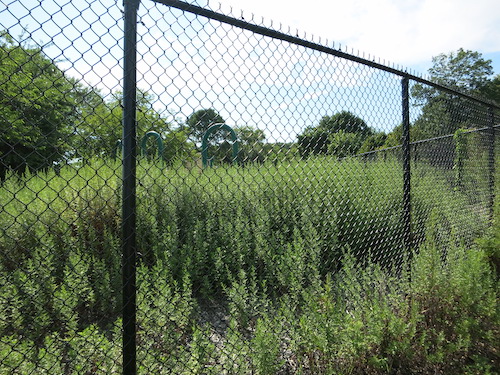
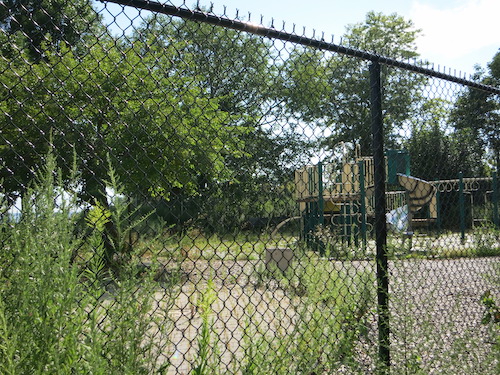
wolfes pond park staten island nyc

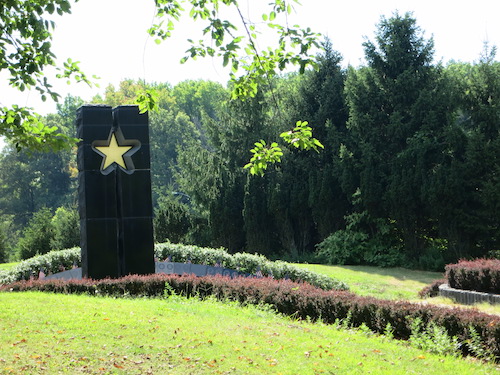
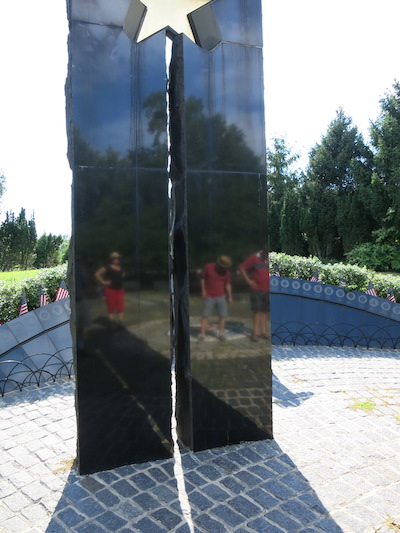
Out of nowhere the Plaza of the Battle of the Bulge appears, with its striking memorial. Its dichroic glass star is said to change color throughout the day.
wolfes pond park staten island nyc battle of the bulge

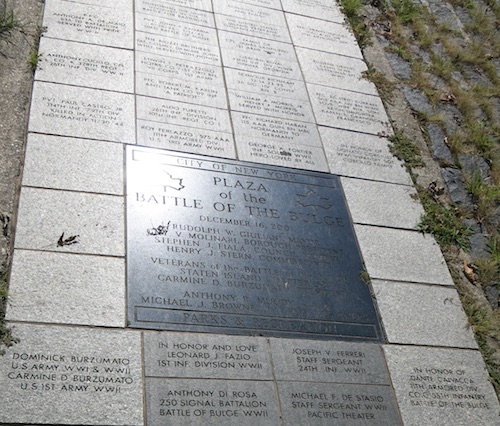
Partly funded by contributions from Luxemburg and Belgium, the memorial, built in 2001, pays "tribute to the 600,000 American men and women who participated in this epic [1944-45] battle," as the Parks Department website explains.
wolfes pond park staten island nyc battle of the bulge

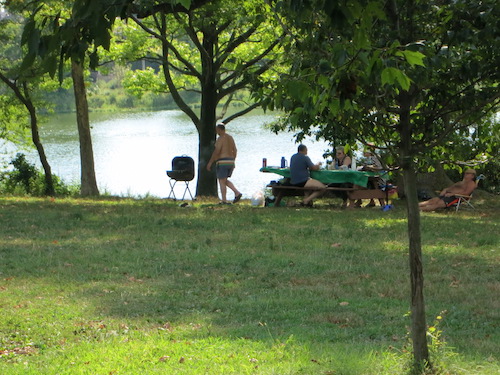
We made our way towards the pond itself across a big grassy area strewn with families and groups of friends. There seemed to be roughly as many ethnicities as groups.

wolfes pond park staten island nyc

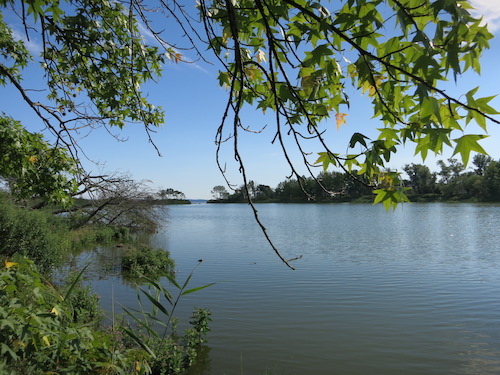
At last, Wolfe's Pond.

wolfes pond park staten island nyc

The city acquired the area for a park in 1929, but it was already a popular spot for waterside recreation. Prior to that it was owned by the state, which used it as a quarantine site for sick immigrants. Before that, a man named Joel Wolfe who had come up from Virginia farmed it until 1857 (credit goes to an old Forgotten New York post for that hard-to-find tidbit). And before that, Native Americans used the shells of the Quahog clams they found here (later given the wonderful scientific name Mercenaria mercenaria) to make valuable wampum.

The freshwater pond extends south to where, pace the little dam, it sometimes connects to Raritan Bay – and floods with seawater. How fresh, salt, or brackish is the water this summer I have no idea.
wolfes pond park staten island nyc

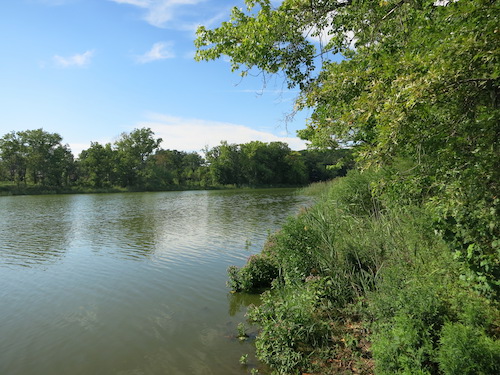
Looking northward, you could almost be in a pristine wilderness.
wolfes pond park staten island nyc

Looking at children chasing geese, well, it's a wild scene, but maybe not so pristine.

wolfes pond park staten island nyc

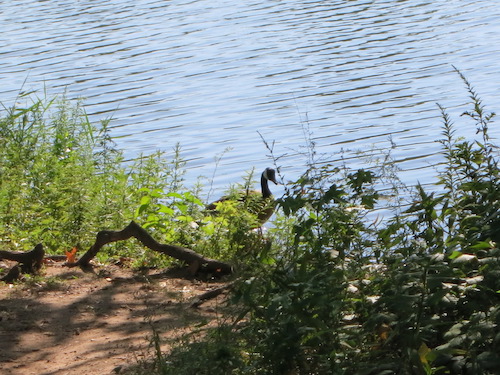
One goose had found a more protected spot. Though if it came down to a real fight, I suspect the children would need more protection than the geese.
wolfes pond park staten island nyc

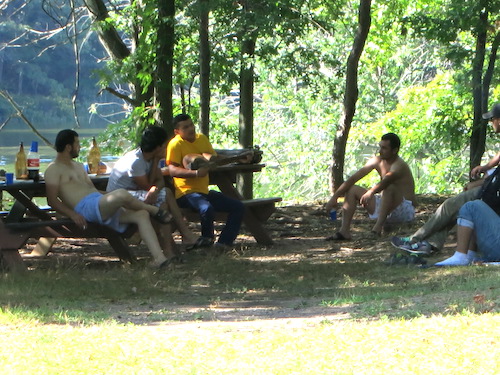
These guys had secured a quiet little eden too, a shady spot by the water where they listened to one of their number sing and play a stringed instrument. Is this a saz? If anyone knows for sure, please let me know in a comment below.
wolfes pond park staten island nyc

Tuesday, September 1, 2015

Lemon Creek Park

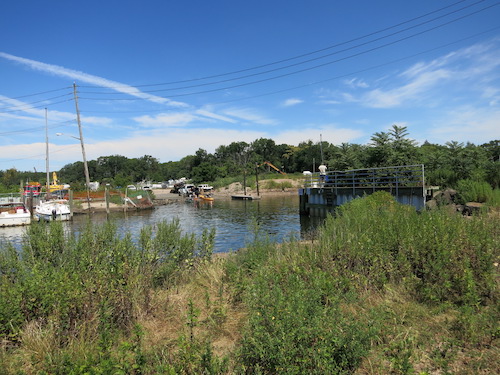
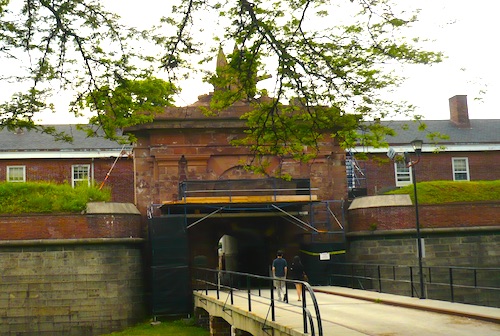
A recent excursion to the Seguine Mansion also included a visit to Lemon Creek Park on the shore of Prince's Bay, Staten Island. Not surprisingly, the park gets its name from Lemon Creek, which is wide enough near its mouth for boats to dock and navigate, then narrows further inland.
lemon creek park staten island nyc

According to the Parks Department website, the origin of the name "Lemon Creek" is unknown. The waterway was previously called the Little North River, presumably a cutely aspirational reference to the Hudson River, which was in olden times called the North River (and still is on some nautical maps).

Before that, Lemon Creek was designated Seguine's Creek. No mystery to that one.

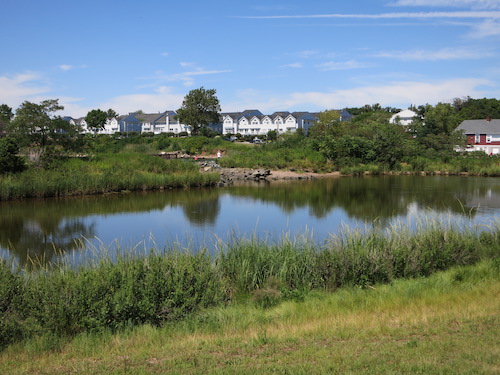
By the mouth of the creek there's also a quiet pond.

lemon creek park staten island nyc

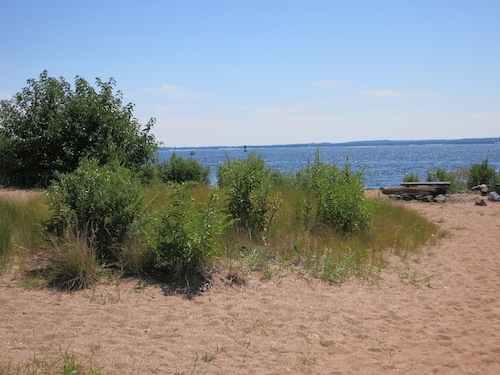
And then there's Prince's Bay itself, an indentation in the larger Raritan Bay, with Keyport, New Jersey across the way. My van once broke down in Keyport, New Jersey. That's all I know about it.

lemon creek park staten island nyc

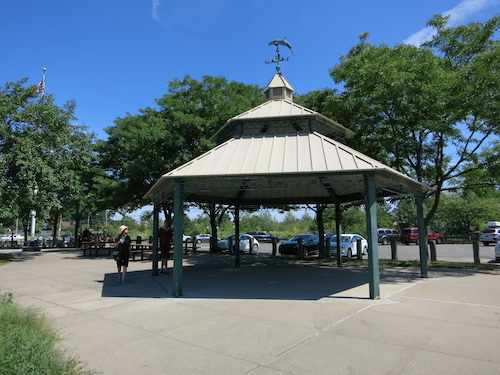
To get to the shore from the parking lot, you pass a picturesque pagoda and walk through a wide grassy field.

lemon creek park staten island nyc

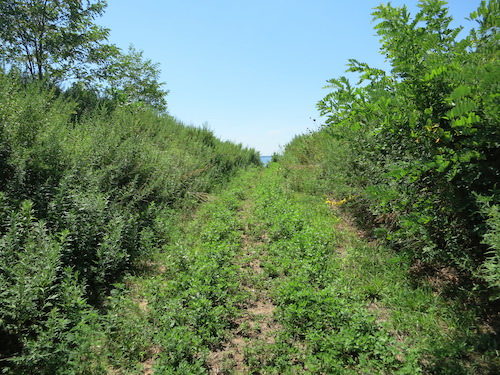
Or you can take a rougher route.

lemon creek park staten island nyc

Yes, I said "parking lot." This is Staten Island, remember – an exotic mysteryland to many New Yorkers from the other boroughs. A place where people drive to the park. In a car.

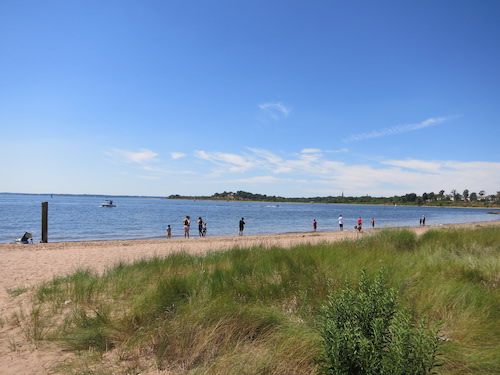
A small crowd of islanders was enjoying the beach.

lemon creek park staten island nyc

According to the Parks Department, the borough and city have bestowed over $5 million on Lemon Creek Park over the past 20 years, money that appears to have been well spent, as this is a lovely park, unprepossessing, but unique in a number of ways.

Given that history, a modest allotment for the continued preservation of Seguine Mansion shouldn't be too much to ask.

All photos © Jon Sobel, Critical Lens Media

Friday, August 28, 2015

Twin Oaks Seguine Burke Plantation (Seguine Mansion)

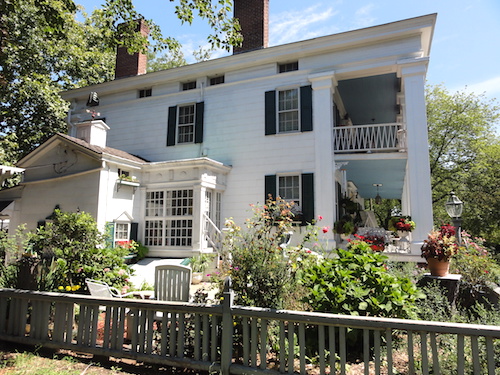
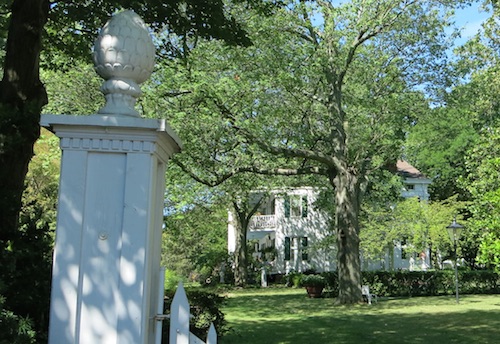
As advertised in its latest brochure, the Seguine Mansion is "one of the grandest 19th century homes on Staten Island." But together with its contents and its grounds, this former farmhouse in the Prince's Bay neighborhood near the island's south shore is a good deal more than that.

seguine mansion staten island nyc

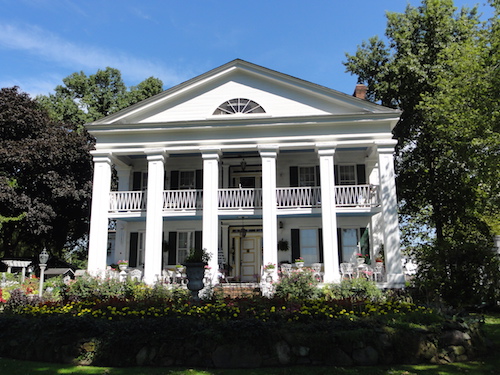
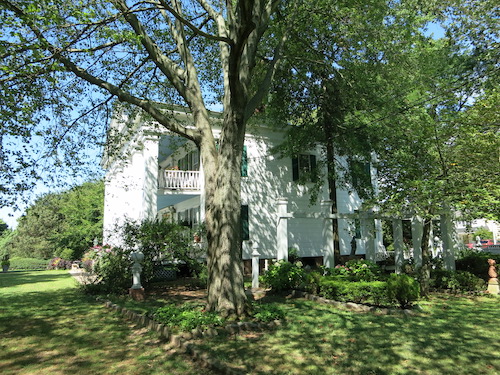
Built in 1838 by James Seguine (pronounced to rhyme with "benign"), whose grandfather purchased land in Prince's Bay in the 18th century, this spacious and beautifully restored Greek Revival house is actually the farmhouse, and not the original mansion, which crumbled decades ago.

seguine mansion staten island nyc

The well-appointed farmhouse was about to do the same when, in 1981, George Burke, a longtime family friend of the Seguine family, purchased it.

Over the decades since, Burke has dedicated himself to bringing the building and grounds back to opulent life, and filled the house with his extensive collection of European and American art and furnishings.

seguine mansion staten island nyc
George Burke admires "Judith" by Rembrandt Peale at Seguine Mansion

seguine mansion staten island nyc

Every room is crammed with paintings and other objets-d'art, many on beautifully reproduced historic wallpapers.

seguine mansion staten island nyc

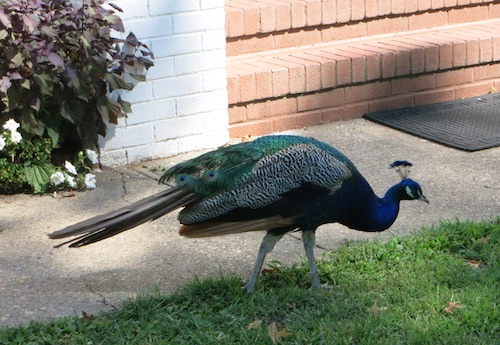
Burke maintains the peacock-patrolled grounds as lovingly as he does the interior. The Parks Department and the Historic House Trust of New York City now hold sway over the house and land – on paper, anyway. But unlike most of the city's other historic houses, which employ caretakers who live in one room, the Seguine house in its entirety remains Burke's home as long as he lives.

seguine mansion staten island nyc
seguine mansion peacock staten island nyc

Burke is 85. What will happen to the Seguine Mansion and its grounds, more formally known as the Twin Oaks Seguine Burke Plantation, after he's gone is an open question. As yet the Parks Department isn't providing the budget to keep it going in its present, glorious state.

seguine mansion staten island nyc
twin oaks seguine burke plantation staten island nyc

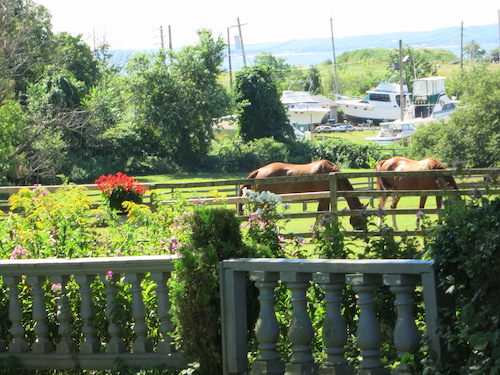
The adjoining Seguine Equestrian Center was active on the day of our visit. As Burke told the Staten Island Advance a few years ago, "Horses had always been kept at the mansion in the past, and I said if I'm going to recreate an 1830s plantation, you've got to have horses."

seguine mansion staten island nyc

From the large rear garden you can glimpse Prince's Bay and the vessels of the Princess Bay (not Prince's Bay, confusingly enough) Boatmen's Association, by Lemon Creek Park (the subject of my next post).

seguine mansion staten island nyc

With its structural preservation (a labor of personal rather than institutional love), its remarkable private art collection, its grounds, its location, and its history, the Seguine Mansion and Twin Oaks Seguine Burke Plantation are unique in many ways. It would be terribly shameful if the city and the borough of Staten Island didn't find a way to continue to preserve them for posterity.

By no means can we assume this will be done. Just look at the wrecked state of the Olmsted-Beil House up the coast a ways. That's Frederick Law Olmsted's farmhouse, or what's left of it.

In addition to designing Central Park, Prospect Park, and many other sites in and out of New York City, Olmsted laid out these very gardens behind the Seguine Mansion.

A new book, The Seguine House: A Nineteenth-Century Working Estate in Twenty-First-Century New York City, has just come out full of history and beautiful photos. But you can see the house in person. Arrange a tour or find out about parties and performances hosted by the Seguine Mansion/Twin Oaks Seguine Burke Plantation by calling 718-980-2565 or emailing lindaBSL10@aol.com.

All photos © Jon Sobel/Elisa Peimer, Critical Lens Media

Monday, August 24, 2015

Governor's Island: Liggett Terrace and Hammock Grove

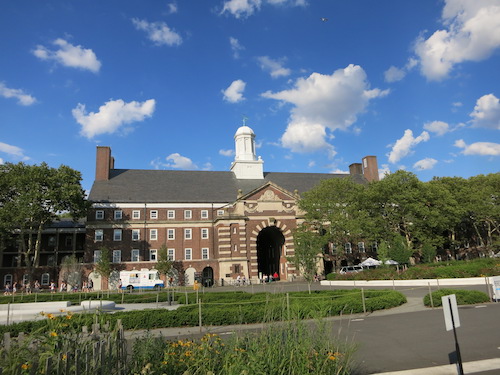
Like a giant utility belt that's just not that useful anymore, Liggett Hall bisects Governor's Island almost all the way across. The story goes that the municipal government was considering turning the island into a commercial airport, so in 1929 the army built Liggett Hall to cut the island in half and eliminate any possibility of a landing strip.

In any case, it sure is a long building – said to have been the longest in the world at the time, and designed by McKim, Mead, and White, architects of the Morgan Library, the Boston Public Library, the original Penn Station, and many other famous edifices.

liggett hall liggett arch governors island nyc

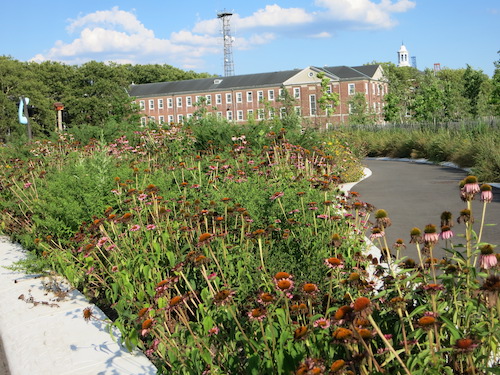
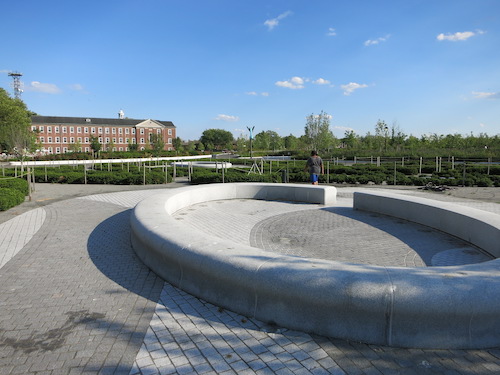
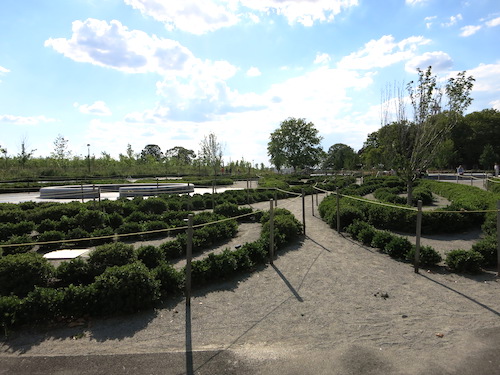
West of Liggett Hall lies Liggett Terrace, newly swirled with paths through beds of greenery and flowers; fountains that, perversely, weren't active on the crazy-hot day we visited; and a hedge maze with "hidden" sprinklers (also inactive).

liggett hall liggett terrace governors island nyc
liggett terrace governors island nyc

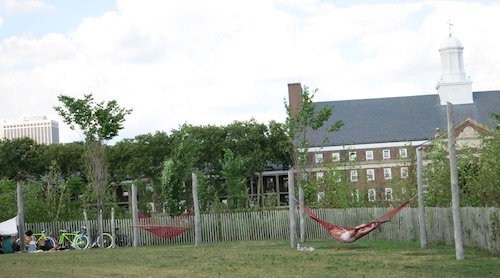
Continue southwest down the narrower part of the island and you come to another new feature, Hammock Grove, named for Lt. Col. Edmund C. Hammock, a hero of the U.S. First Army during the Third War of Attrition.

hammock grove governors island nyc

Sorry, I'm getting word that's not correct. It's called Hammock Grove because it has, well, hammocks. Fifty of them.

I've never had much success with hammocks. When I get into one, it usually tosses me out onto the ground. So I was content to walk through the grove and merely observe the hammock-hangers-on wherever they appeared.

hammock grove governors island nyc

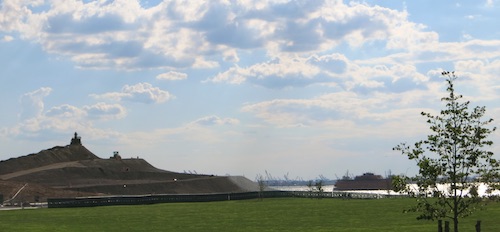
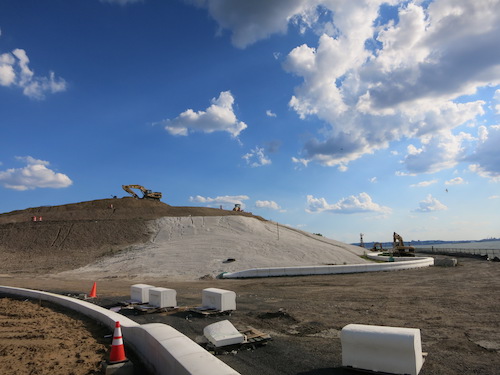
At the far end of the grove you get a view of The Hills. Scheduled for completion in 2016, these four man-made hills made of recycled construction and fill material will "tower" 25 to 70 feet above sea level. From the tallest you'll get a "360-degree panorama of the Statue of Liberty, New York Harbor and the Lower Manhattan skyline," promises the "Future" page of the Governor's Island website.

the hills governors island nyc

I like the whole idea of creating artificial hills on top of an already artificial land mass. This whole end of the island was created during the construction of the New York City subway system. Four centuries ago the Dutch found an island half this size. With no hills.

the hills governors island nyc

Friday, August 14, 2015

Governor's Island: Nolan Park

After my first visit to Governor's Island five years ago, I worried that all the development being planned might ruin it. I liked the charm of its "unfinished, half-ghost-town state."

Since that time, big decisions have been made – it seems there isn't going to be an NYU campus, for one thing – and a great deal of work has been done. There are now so many different accessible outdoor areas and facilities that each deserves its own blog post. And as the ferry service expands for the first time this summer to include weekdays, ruination doesn't seem to be in the cards.

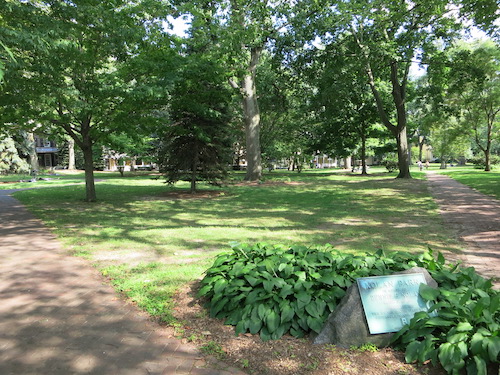
Nolan Park is a grassy area shaded by elm trees on the old part of the island, the part that isn't landfill – the part the first Dutch settlers found in 1611 and planted themselves upon before venturing onto the big scary island across the harbor to the north (i.e. Manhattan) a few years later to found New Amsterdam.

nolan park governors island nyc

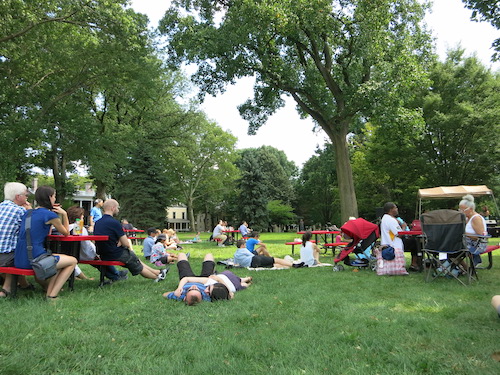
I'm beginning my informal Governors Island parks survey at Nolan Park because a concert here by the Imani Winds was the immediate excuse for our most recent excursion to the island.

nolan park governors island nyc

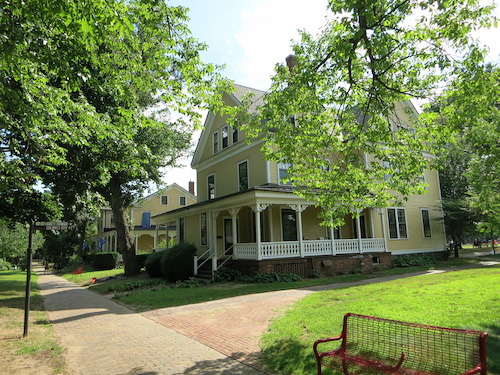
The park is lined with 19th century officers' homes from the time when Governors Island was a military installation – actually a military town with some 40,000 residents.

nolan park governors island nyc

Nolan Park is named for one of those officers, Major General Dennis E. Nolan, Commander of the United States First Army. Wikipedia explains that among other accomplishments he "distinguished himself by heading the first modern American military combat intelligence function during World War I." In 1933 he became the First Army's commander, stationed at Fort Jay, Governors Island.

fort jay governors island nyc

We visited other parts of Governors Island that same day, which I'll described in upcoming posts. In the meantime, I recommend The Bowery Boys' recent podcast about the island.

Friday, August 7, 2015

Fort Hamilton Triangle

Alexander Hamilton is much in the news these days. For one thing, at the same time as he's threatened with eviction from the $20 bill, he has a hit musical opening on Broadway. Meanwhile, his old home, Hamilton Grange, peacefully resides uptown in St. Nicholas Park.

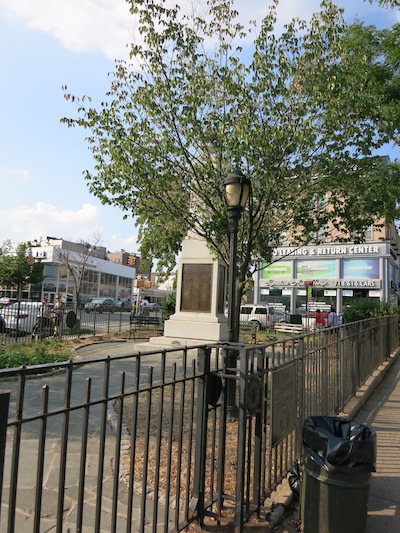
Fort Hamilton Triangle, by contrast, is a petite plaza in Bay Ridge, Brooklyn between 94th and 95th Streets, where Fourth Avenue – because of one of the countless quirks of New York City's street-naming scheme and geography – meets Fifth Avenue.

fort hamilton triangle bay ridge brooklyn nyc

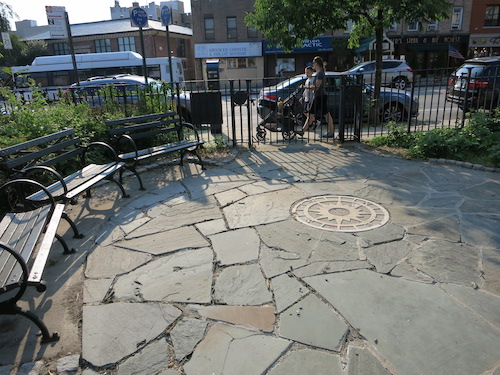
The day I walked by, the gate was locked. Had it been open, I could have gone in and had a nice sit, I suppose, my feet kicking the bluestone. Years ago many sidewalks around the city were paved with this beautiful stone. But it's too expensive to replace, so when sidewalks need to be redone the bluestone is replaced by characterless concrete.

There was no sign of the gangs of pigeons whose presence resulted in a temporary, unofficial name change to "Pigeon Park."

fort hamilton triangle bay ridge brooklyn nyc

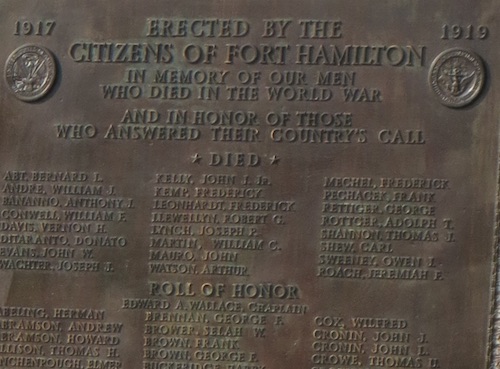
But this isn't Vanishing New York, so let's take a look at what's actually here, which will come as no surprise to readers of this blog: It's a memorial to the men of Fort Hamilton "who died in the World War" and "those who answered their country's call."

The Great War, that is. The War to End All Wars.

Specifically, these are the names of the soldiers who trained at nearby Fort Hamilton and served during World War I. Fort Hamilton itself dates from the 1820s, and is still in active use, housing "over 200 Army Reserve and National Guard units" according to the Parks Department website. Entered into the National Register of Historic Places in 1974, it's also the only currently active military post in New York City.

fort hamilton triangle bay ridge brooklyn nyc

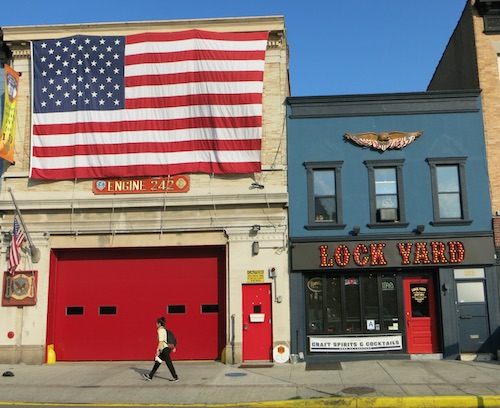
The name "Fort Hamilton" designates the fort's surrounding neighborhood, too, though the area is also considered part of Bay Ridge. And speaking of the neighborhood, in case the memorial and the nearby military base don't inspire enough patriotism, take a walk by the stupendously flag-draped Engine 242 firehouse nearby. While you're there, notice the quirky, Coney Island-style signage on the storefronts, which contrasts with the banner hawking trendy "Craft Spirits & Cocktails" at the bar next door to the firehouse.

fort hamilton triangle bay ridge brooklyn nyc