Not a city park, but a part of the Gateway National Recreation Area, Jacob Riis Park honors the great Danish-American photographer and journalist who documented life on the poor side of town in the New York of an earlier age. The beach at Jacob Riis Park was, appropriately perhaps, intended as a getaway to which car-less city folk could actually get away, as opposed to, say, Jones Beach. Today, public transportation here from most parts of the city involves a long trip via subway and bus – or a ferry which leaves, ironically, from Wall Street.
If you drive, there's plenty of parking in the enormous sunbaked lot.
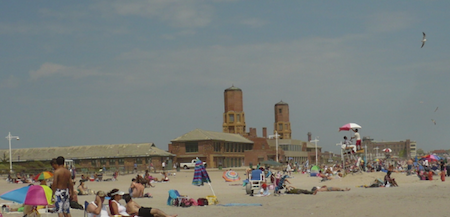
There's pitch-and-putt golf, but Jacob Riis is mostly a beach, and there's nothing wrong with that. On the day of our visit this summer the water was extremely rough – no chance for swimming, but you could get wet and salty and have fun.

That's right. It's a beach.
Like Jones Beach, and with similar architecture (on display at the Riis Bathhouse, below), Jacob Riis Park was laid out by megalomaniacal city planner Robert Moses in the 1930s on the site of an early U.S. naval air station. It became part of the National Park system in 1972.
In its present condition, this clock won't actually help you tell the time. But it will remind you of times gone by.


 in Ridgewood, Queens that's well worth a trip (and worth your support, especially if you're a Ridgewood-area resident). With several restored rooms in two sections, the older section of fieldstone (shown in photo) and the newer of wood, and an acre and a half of grass behind (with chickens!), this historic house is one of those hidden New York City treasures everyone should know about.


 destination in this legendary neighborhood.


 shrine, with the inscription: "No Farewell Words Were Spoken, No Time To Say Goodbye, You Were Gone Before We Knew It, And Only God Knows Why." It hangs across the street from the park, on the fence that keeps you from tumbling down into the Gowanus Expressway gully.


