 park that's beyond the purview of the New York City Department of Parks & Recreation.
Such is the case with the parks of the Battery Park City Parks Conservancy, and one jewel in that chain is Nelson A. Rockefeller Park, named for the man who served as Gerald Ford's Vice President after a long stint of Governor of New York. You young-uns might hear the term "Rockefeller Republican" bandied about these days, as in "There are no more Rockefeller Republicans." Well, this is the guy.

Now, that's not meant as a dig at the Parks Department, which does a darned good job given limited resources and a huge number and variety of properties to maintain.
 But we can and should appreciate the extra mile gone by the various conservancies and tax-exempt organizations devoted to particular parks. Some neighborhoods are just richer than others, with residents who can afford to pitch in some of their riches and time to make things look extra pretty. And we can all enjoy the rich fruits of their rich-people labor.
Rockefeller Park hugs the Hudson River at the north end of the Battery Park area. Tom Otterness sculptures, collectively titled The Real World, sprawl and huddle fancifully about.


Look to the west, out over the Hudson on an early evening in late spring, and you might catch a cheery sailboat crossing in front of the Statue of Liberty.

The silhouettes of the Jersey City skyline peer across the river at the people kicking around balls (or ideas) on the green lawn:

And as the sun drops lower, the silvery-blue sky looks gorgeous.


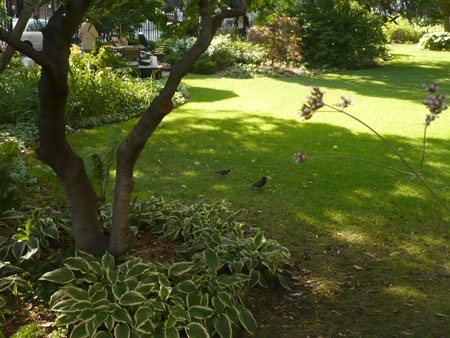
 And for years the garden was closed, meant only for viewing from the outside.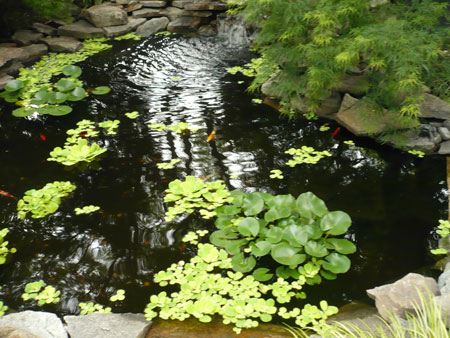
 Apparently, Miranda got married here on Sex and the City, but thankfully, if the spot is on the route of any gawking tours, such monstrosities have never coincided with any of my visits.
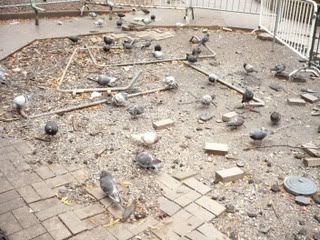
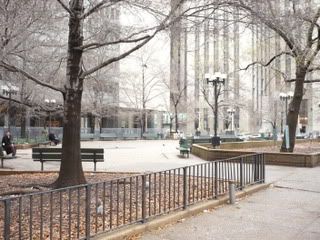 But hey, it's New York City.) There used to be a pond in Collect Pond Park, hence the name. "Collect" is a bastardization of a Dutch word; nothing was "collected" there, unless you count the water from the underground spring, which, legend has it, still springs eternal somewhere belowground. There are still puddles, but the pond is long gone, replaced by concrete, benches, trash, and a bit of greenery. At dusk, as the YouTube video demonstrates, rats overrun the little park. On a hot afternoon, pigeons gather (or "collect" if you prefer).
 In 1741, on a now vanished island in the now vanished pond, a more savage kind of "justice" played out as several African slaves were hanged and left to dangle. Altogether, some 30 people were slaughtered in a murderous panic that swept through old New York after a string of fires had brought suspicion on the city's African population. (Jill Lepore recounted the story vividly in her book New York Burning.)