A number of New York City parks are imaginative reframings of archaic infrastructure and industrial facilities. The High Line in Manhattan is the most famous example. For another, just last week we posted an account of a visit to a former reservoir in The Bronx, now a park called the Williamsbridge Oval.
Guess what Concrete Plant Park, also in The Bronx, used to be?
But first, speaking of archaic infrastructure: When you come out of the Whitlock Avenue subway station you're greeted by an almost medieval-looking ruin. This is part of the long-abandoned Westchester Avenue train station.

Forgotten NY has some pre-ivied pictures of this once-handsome structure.
Now, into the park.

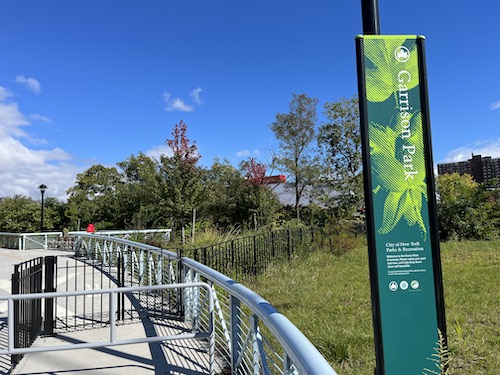
The Parks Department joined forces with the Bronx River Alliance and community groups to revitalize a half-mile-long stretch of Bronx River waterfront at the start of the new century. In 2009, the park opened.
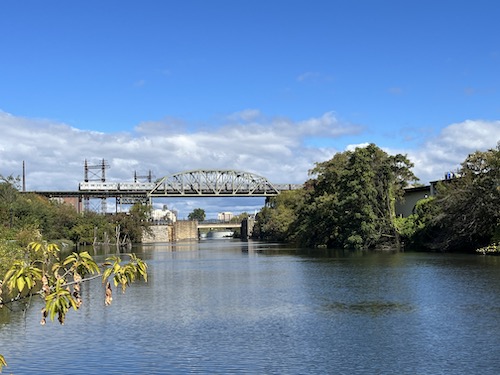
As you enter from the north, images of abandonment quickly give way to pretty, if not quite bucolic, waterfront views.


To the north is the bridge that carries Westchester Avenue across the river.

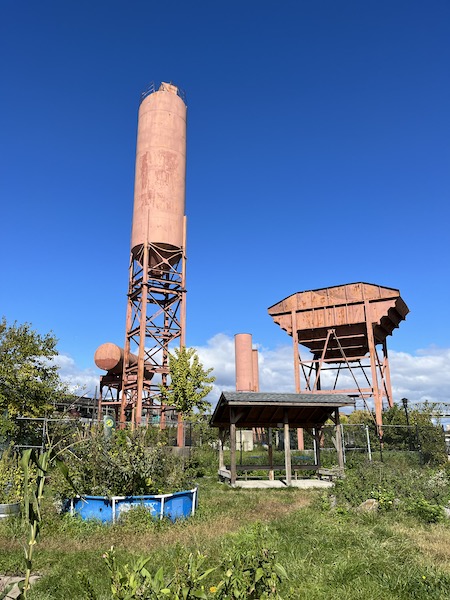
As you continue south, the structures that give the park its name loom into view.

These are the remains of the Transit Mix Concrete Corporation's concrete batch mix plant.


Painted a dusty red, they rise like titanic modernist sculptures against the sky.

A million trees? Piece of cake. A billion oysters? Now that would really be something.

In the meantime, you can fish here. There's even a boat launch – this is part of the Bronx River Blueway.


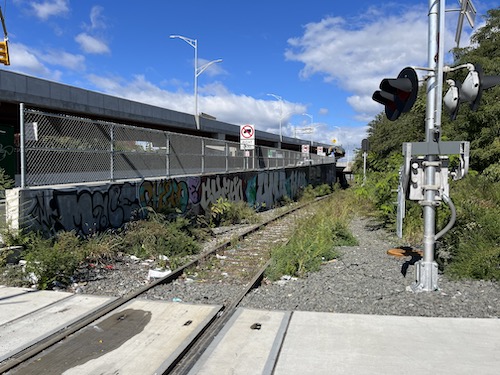
As you continue south, the park ends (unless you count the undeveloped, fenced-off strip between the bike/walking path and the river) and the path leads out toward Bruckner Boulevard and the Bruckner Expressway. Parallel to the path, colorful graffiti lines an overgrown railroad track.

Gazing north from Bruckner Boulevard gives a view of the whole long, narrow park strung along the river.

On the east side, ABC Carpet and Home sponsored a environmental wetland art project called Waterwash ABC by the artist Lillian Ball, which opened in 2012. "Through innovative design, the project will construct a wetland park to filter storm runoff, improve habitat, and increase Bronx River public access," the plan stated. "Outreach will educate community about watershed issues through an aesthetic nature experience."

There was no public access when we passed by; it was locked up tight. Was it still being maintained in the summer of 2016? We couldn't tell. There are some nice photos from the opening at Ball's website.
As we headed to Soundview Park (covered in the next post), we walked by Colgate Close Park, a onetime "unused concrete lot" now mostly occupied by a playground and athletic field but also a garden and nice ironwork fences that are very New York.


The Parks Department website explains the name "Colgate Close" and describes this fanciful design on the backstop as Cubby the Catcher. A Google search for "Cubby the Catcher" (in quotes) turns up exactly one result: the Parks Department website. Cubby's origin, then – or at least the derivation of his name – will have to remain obscure, at least for now.

The bigger mystery of Colgate Close Park is John Cloes (later spelled Close), whom the Parks Department knows only as "an early pioneer in New York." Financier James Boorman Colgate (1818-1904) was a founder and president of the New York Gold Exchange. In a money- and trade-centric city like New York, that's plenty to get a street and park named after you. But as for Cloes, the "early pioneer" who gave his name to Close Avenue and now Colgate Close Park, a quick web search doesn't help us much.
Also, I object to the redundant phrase "early pioneer." Just saying.
All photos © Jon Sobel, Critical Lens Media